


The foundation of the second Trump administration was built upon a commitment to ending “forever wars” and preventing the escalation of global tensions into World War III. Throughout the 2024 presidential campaign, Donald Trump and his running mate positioned themselves as the “pro-peace ticket,” contrasting their “America First” agenda with what they characterized as the interventionist failures of the Biden-Harris administration.
During the campaign, Trump repeatedly asserted that his negotiation skills would deter conflicts before they began. He famously declared at a 2023 rally in New Hampshire that his administration would “expel the warmongers” and “drive out the globalists” who “love seeing people die”.
“I will prevent World War Three and you are very close to World War Three”
Upon his inauguration in January 2025, the President’s inaugural address reinforced this peacemaker persona, stating that the success of his administration would be measured not only by battles won but by “wars we never get into”. This rhetoric was almost immediately tested by the failure of diplomatic efforts to secure a new nuclear agreement with Tehran. Despite initiating a series of indirect talks in Oman and Rome early in 2025 — which the administration initially described as “constructive” — the White House quickly reverted to a “maximum pressure” campaign.
Nov 2024 “I’m not going to start a war. I’m going to stop wars.”
Jan 20, 2025 Success is measured by “the wars we never get into.”
Feb 6, 2026 Addressing threats by the Government of Iran.
Feb 28, 2026 “Massive and ongoing” attack aimed at regime change.
The transition from the “peace candidate” to the commander of Operation Epic Fury was not a gradual shift but an abrupt pivot. By February 2026, the administration was stuck in a military intervention which has every chance of creating over into the very World War he’d explicitly campaigned to prevent.
The Twelve-Day War
The narrative template for the 2026 conflict was established during the brief but intense “Twelve-Day War” in June 2025. This conflict, which followed the International Atomic Energy Agency’s finding of Iranian non-compliance, saw the United States join Israeli strikes against Iranian nuclear and military infrastructure.
On June 24, 2025, President Trump announced a ceasefire, framing the operation as a definitive success. In his subsequent State of the Union address, he claimed that Iran had been “warned” and that their nuclear ambitions had been effectively halted, but the developments following the ceasefire clearly contradicted that narrative. Fearing further attacks, Tehran began rebuilding its missile factories and nuclear sites almost immediately, utilizing dual-use inputs from China to bypass sanctions.
This 2025 conflict showed Trump’s preferred strategy: apply massive force early, set very high expectations, then declare victory as soon as possible. The long-term strategic outcome, wasn’t then, and isn’t now a clear feature in the White House communication strategy. So the attack was memory holed, but that doesn’t mean its reverberations had stopped. It had set in motion a chain of events that would embroil America in war with no clear off ramp.
Its Complete and it’s beginning
When the United States and Israel launched Operation Epic Fury on February 28, 2026, the administration’s communication focused heavily on the brevity and ease of the upcoming campaign. President Trump initially projected that the military operations would last “four weeks or less”. This attempt to define the war as a “short-term excursion” or a “little excursion” was central to managing domestic political expectations and global financial markets.
However, as the conflict entered its second week, the administration’s timeline was breaking apart. While the President claimed the war was “very complete, pretty much” and that he could stop it “any time I want,” his subordinates offered a more cautious outlook.
Mar 2, 2026 “Four weeks or less.” says Trump
Mar 3, 2026 Pete Hegseth says it “Won’t happen overnight.”
Mar 3, 2026 Trump says “Capability to go far longer.”
Mar 4, 2026 Hegseth says “Could be six, it could be eight [weeks].”
Mar 9, 2026 “Very complete... pretty well complete.”
Mar 9, 2026 The Department of War: “We have only just begun to fight.”
The contradiction between Trump’s “complete” narrative and the Pentagon’s “only just begun” statement highlights the administration’s struggle not only to communicate a clear strategy, but to have one. During a press conference on March 10th, a reporter challenged Trump, how can the war be “very complete,” whilst Hegseth said, “This is only just the beginning”
“So which is it?” the reporter asked. “Well, I think you could say both” Trump replied. Its both the beginning and complete.
The Sunken Navy that Mined the Strait
A primary theme in the administration’s “winning” narrative was the alleged annihilation of Iran’s conventional military capabilities. On March 9, 2026, President Trump claimed that the Iranian Navy was “gone,” lying at the “bottom of the ocean”. He specifically cited the sinking of “46 top-of-the-line” Iranian vessels over a three-and-a-half-day period, jokingly remarking that his commanders thought it was “more fun” to sink them than to capture them.
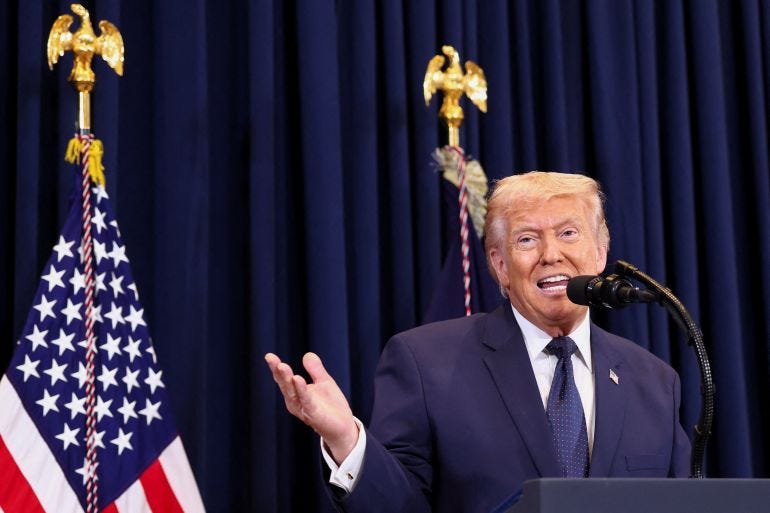
These claims were paired with assertions that Iran’s drone and missile capabilities had been “utterly demolished” and reduced to a “trickle”. Secretary Rubio echoed similar statements, suggesting the US was ‘getting the job done’ and seriously degrading Iranian capacity.
But on the ground, evidence suggested a more resilient Iranian threat. While the conventional Iranian Navy had indeed suffered heavy losses, the regime was successfully operating asymmetric naval warfare, using smaller boats to lay mines in the Strait of Hormuz — a tactic that successfully maintained a stranglehold on global oil transit. Furthermore, despite claims that missile launchers had been 80% destroyed, Iran continued to launch hundreds of drones and ballistic missiles against U.S. bases in Qatar, Bahrain, Kuwait, and Saudi Arabia well into the second week of March. The UAE ministry of Defense continues to post daily updates on the Iranian missile threat they deal with on a daily basis.


March 9th: “Navy is gone... lying at the bottom of the ocean.” but Iran was using small boats to lay mines in the Strait.
March 9th: Missile capability is “largely knocked out” but UAE is still dealing with ballistic missiles and Iran launched “hundreds” of drones and missiles at bases.
March 11th “Practically nothing left to target.” Ongoing retaliation in Lebanon, Iraq, and Persian Gulf.18
The administration’s rhetoric relied on a binary view of military strength — assuming that the destruction of “top-of-the-line” assets equaled the cessation of hostilities. Trump was now telling the press “Any time I want it to end, it will end”. In reality, the Iranian resistance remained operational, with the regime in Tehran declaring that they, not the United States, would determine when the war ended.
The Iranian strategy, to choke the global economy by closing the Strait of Hormuz, was clear and effective. Policy writers on Substack made clear that “top-of-the-line” damage to Iran’s interior bears no real effect on Iran’s ability to use asymmetric tactics to ensure ships cannot cross the strait.
Whilst Iran’s defensive strategy remains clear, it has been near impossible for the Trump administration to express a coherent rational on why the war started, nor coherent objective which might end it.
The (lack) of an “Imminent Threat”
The legal and political justification for the 2026 strikes underwent serious whiplash. Initially, Secretary Rubio and House Speaker Mike Johnson characterized the operation as a “preemptive” and “defensive” measure. Rubio’s exact words on March 2nd will likely be studied in years to come. Asked if there was an “imminent threat”, he replied:
“There absolutely was an imminent threat, the imminent threat was that we knew that if Iran was attacked, and we believed they would be attacked, that they would immediately come after us... if we waited for them to hit us first, after they were attacked, by someone else, Israel attacked them, they hit us first, and we waited for them to hit us, we would suffer more casualties and more deaths”
Critics argued that Rubio’s statement made clear it was Israel that had dragged the United States into war because “[Iran] were attacked, by someone else, Israel attacked them”, forcing a pre-emptive hit against the “imminent threat” from Iran. Trump asserted that Tehran was prepared to strike “within a week” and that the U.S. had “pretty good proof” of missiles aimed at Qatar, Saudi Arabia, and the UAE.
This “imminent threat” narrative was contested on the very same day following a classified briefing. Senator Mark Warner, the top Democrat on the Senate Intelligence Committee, explicitly stated the intelligence didn’t support Rubio or Trump’s position. “There was no imminent threat to the United States of America by the Iranians”.19 Warner warned that equating a threat to Israel with an imminent threat to the U.S. was “uncharted territory”.
As the justification for the initial strike fell apart, the Trump rhetoric moved up a gear toward demanding “unconditional surrender”. White House Press Secretary Karoline Leavitt explained that this meant something different than unconditional surrender, arguing the war would continue until the President determined that Iran “no longer poses a threat,” essentially putting the U.S. in a position to declare that Iran have surrendered “whether they [Iran] say it themselves or not”.
This shift from a defensive “preemptive” strike to a demand for “unconditional surrender” and “regime change” is a profound contradiction at the heart of the Trump administration’s stated foreign policy goals. While the President had previously derided “nation-builders” and “neo-cons” for wrecking nations in the Middle East, he is now actively seeking to topple the Iranian government and personally participate in the selection of its new leader.
When Mojtaba Khamenei was named as his father’s successor on March 8, 2026, the administration’s response was one of uniform rejection. Trump labeled the appointment as “unacceptable” and dismissed the new leader as a “lightweight”. His insistence that any new Iranian leader must have U.S. approval before being recognized underscored the administration’s pivot toward regime change. Rubio seemed to directly contradict this, telling Arab foreign ministers they wanted “different people running the country”, but that this was “not regime change”. It’s not clear how you can demand different leadership without wanting regime change.
Donald Trump - any new leader “Must get approval from us.”
Marco Rubio - “Goal is not regime change... want different people.”
Donald Trump - “I’m not going through this to end up with another Khamenei.” immediately after Khamenei’s selection
The public contradictions have created a confused strategic outlook. Does Trump want unconditional surrender? Does the administration aim to install a new government? If they don’t want a new government, what does victory actually look like? As these questions were starting to emerge, one Iranian endpoint for success had remained constant
The closure of the Strait of Hormuz
The closure of the Strait of Hormuz on March 2, 2026, led to an immediate surge in global oil prices, with crude hitting $120 per barrel and markets entering a state of shock.
Energy Secretary Chris Wright and Press Secretary Karoline Leavitt repeatedly insisted that the price increases were “only temporary” and would “last weeks, not months”. Wright characterized the crisis as “short-term pain to solve a long-term problem,” suggesting that once the U.S. “defanged” Iran, prices would drop significantly
Mar 9, 2026 — Chris Wright said disruption is “temporary,” while oil hit $120/barrel with 20% of global supply cut off.
Mar 10, 2026 — Karoline Leavitt said costs will go down after the operation ends, while analysts predicted $150/barrel if the closure persists.
Mar 11, 2026 — Chris Wright posted (then deleted) a tweet claiming the Navy escorted a tanker; the White House later admitted no such operation occurred.
Mar 12, 2026 — Donald Trump said the economy will quickly “surge and blow it away,” while a massive tanker backlog developed and production was shut in the Gulf.
The reality of the energy market was far more complex than the administration’s “short-term” messaging suggested. Experts noted that even if the Strait were reopened quickly, the physical damage to infrastructure in Qatar and the backlog of tankers would take weeks to clear. Oil production facilities can’t just be turned back on like a hose, even if the strait were opened tomorrow the economy would face months of serious problems in what has been described as ‘largest oil supply disruption in history’.
Furthermore, the administration’s claim that U.S. domestic production could mitigate the crisis ignored the fact that American refineries are incompatible with the heavy crude typically transiting the Strait.
The most embarrassing contradiction occurred when Secretary Wright erroneously posted on social media that the U.S. Navy had escorted a tanker through the Strait, sending oil prices on a “rollercoaster” before the White House was forced to concede the claim was false.
Minimizing Casualties
Another area of rhetorical tension lies in the reporting and acknowledgement of casualties. Defense Secretary Pete Hegseth took a combative stance toward media reporting on the war’s human toll, asserting that the press only highlighted casualties to “make the president look bad”. He dismissed reports of fallen service members as “ahistorical” and “warped,” emphasizing that the “terms of this war will be set by us at every step”.
This refusal to engage with the human cost of the conflict was mirrored in the administration’s reporting of Iranian casualties. While human rights organizations like HRANA and Hengaw reported thousands of deaths, including over 1,300 civilians, the administration maintained that its mission was “the most lethal and precise air power campaign in history.”
The very same say, the US military struck a girls’ school in Minab, which killed 165 people, mostly little girls. Trump initially claimed Iran did it, then claimed the Tomahawk used was perhaps Iranian, or Korean, or ‘something else’. A US military investigation later demonstrated the missile was in fact fired by the American military and was likely due to a targeting error
US Casualties — Administration claims 14 military dead, confirmed by Centcom.
Iranian Military — Administration claims 6,000+ killed; Hengaw independently reports 4,420.
Iranian Civilians — Administration claims minimal/avoided; HRANA reports between 1,319 and 3,000+.
Regional Impact — Administration calls it a “short-term excursion”; independent reports indicate 700+ dead in Lebanon and 100+ in Iraq/Kuwait.
The “unconditional surrender” demanded by the President has not materialized, nor has the “easier than we thought” regime change. Instead, the United States finds itself leading a multi-front war with no clear exit strategy, while global energy markets remain in a state of sustained volatility. The campaign promises of 2024—to avoid World War III and stop “forever wars” have been replaced by a “Trump Doctrine” that emphasizes massive, preemptive strikes and the pursuit of regime change through decapitation.
As the conflict enters its third week, the “short-term excursion” has become a strategic commitment of unknown duration. The administration’s statements, while effective at calming markets or rallying the base in the short term, have created a significant credibility gap that will become impossible to close as the factual developments of the war continue to diverge from the official rhetoric.
might be a good idea if you comment on the Muslim effects on politics in the UK; lot closer to home....