


I sometimes wonder if it’s easier to get to the moon than to fix the information ecosystem we rely upon.
At least the Moon problem can be stated concisely: we need to fly 40,000 kg of cargo into space, across 650,000 miles, and keep it on a carefully planned trajectory. Sure...it’s very difficult, but knowing the exact problem and the exact constraints makes for a challenge that’s well defined, and you can go hard at a well defined problem.
But what happens when we cast our attention toward the information ecosphere? The problem appears persistent and ever present. No matter your goal, you’ll require a lot of things to come out of the information ecosystem. It’s there when you talk with someone online. It’s there in your newsfeed. It’s there when you publish a paper. It’s there when you read a paper, or a book, or an article, or a tweet. It’s there at your job as you consider what to say, and what to avoid. It’s there at your social event when you want to connect, but don’t want to say the wrong thing.
The information ecosystem is a distorting prism. Part system, part psychology, part social, part hierarchy. You have your motivations, and the information ecosystem has its own. All information flowing through it is shaped by those forces at every twist and turn. As you receive that information, you’ll rarely be aware of how far that information has travelled, where it was born, the assumptions that make up its premise, and its perilous journey through contorting forces.
Not only do we rarely, if ever, consider the forces that shape the information we receive, we don’t even notice how dependent we are on its contortions. Do people notice it at all? Have we ever considered “well how do I even know that?” or thought “Why do I even believe that?”
Consider a simple thought experiment: how many experiences of the world have you personally had? Unless you’ve lived an extraordinary life, your first-hand experience of the universe is probably quite limited. Sorry to say it, but for most of us, it’s some variation of eat, sleep, work, repeat.
You also have indirect experience of the universe through the direct experiences of others. But how many people do you actually know? Not people on the internet, not people on the TV, people you’ve really met and connected with. This information can only arrive into your life through a narrow funnel of peers who probably share similar backgrounds and experiences. Your family, friends, and ‘weird contacts’ all make up this secondary direct experience machine.
So how do you actually know anything at all?
The vast majority of your knowledge about the universe has been delivered through the global information ecosystem. That’s your formal and informal education, religious institutions, screens, televisions, radios, and books. Without an intervention from provocateurs (like me), if you consider it at all, you’ll quietly assume this system works reasonably well. “If it’s true... if it’s real...I’d know about it.”
“Oh really?” some imaginary person might say. “Well then why isn’t everyone doing that?” You reply with another apparent revelation.
“Oh yeah!? Well if that were true, it would have been huge news!”
Does this sound familiar? It’s a plausible default position, but any good faith interrogation of the information ecosystem reveals many artefacts that lay waste to this idea.
Your screen is the final ‘endpoint’ for this vast and dysfunctional system. The screen is inanimate. Lifeless. Dead. The information system it’s patched into has no responsibility to tell you anything at all. Without a very deliberate intervention, you are a victim of it, not a participant. Sitting between your phone and ‘the truth’ (whatever that may be) is a distortion field operating at a cosmic scale. You can’t bathe in the swirling plasmic currents of pure truth, and there’s only so much you can personally experience, your screen becomes the receiver for the prism of distortion. You know whatever the prism thinks is OK for you to know.
The everpresent irony? You reading these words on that screen right now.
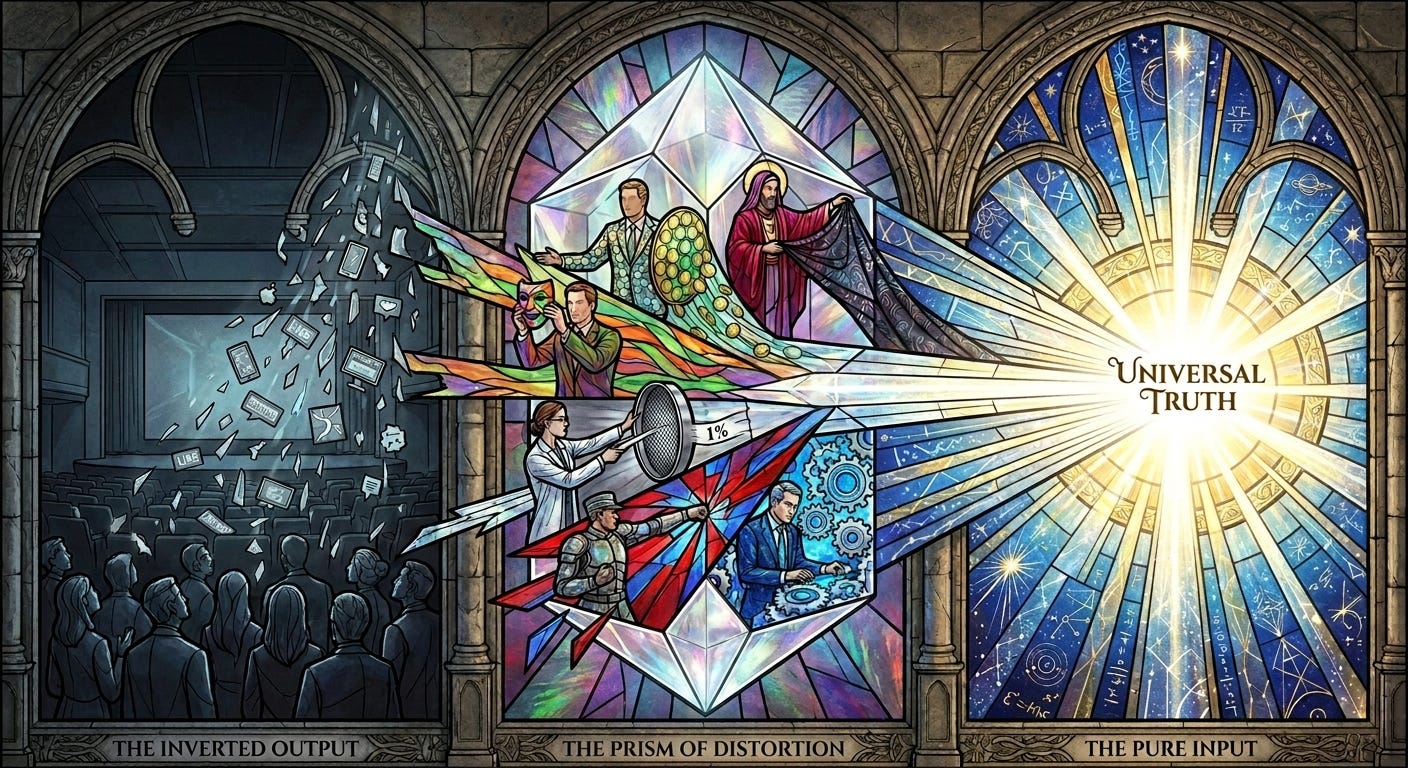
For any special interest, gaining some influence over the prism is a rational move. It will gain you serious influence over society. Can you filter the truth in some way? Can you segment it somehow? Can you taint it with something? A half truth can be a powerful thing. Curation over which truth is accepted, and which is ridiculed, is yet another incredible power.
When you hear people talk about what “The Science” says, you’re hearing an artefact of the system. It’s institutions that get to decide what gets researched. It’s institutions that run sophisticated PR campaigns over their discoveries. It’s institutions that filter out inconvenient results, and it’s institutions which create the derisory culture which polices what’s acceptable. But what choice do you have if you want to ‘do’ science? You must move through the prism. If you want to progress, you’ll need to distort yourself to more closely align with your institution’s distortion. Better still, you could actually believe those distortions wholesale.
Acting as near perfect filters for ideas, ideology, beliefs and perspective, institutions become the greatest hallways inside the distorting prism. Having influence over those hallways gains you massive influence over the default perspective of the educated world. Influence is cheaper than you’d think when you use research grants, sponsorship, incentives, co-creation, collaboration and market forces.
In medical publishing we see this all the time.
“Is it in a peer reviewed journal?”
“Yes” you might respond,
“Well which Journal… because that one has truths of lesser value than mine.”
This is why you hear relentlessly about Wegovy and Ozempic, but hear less on how to moderate hunger with simple additions to the diet. It’s a blockbuster discovery when there’s money riding on it, and it’s an old wives tale when it’s free and simple. With influence over other hallways of the Prism, you can stimulate culture to remain open to medicalisation and be suspicious of ‘other’ health advice.
Your medical advice is curated by the medicine industry.
Your knowledge of war and conflict is curated by the war and conflict industry. Your spiritual knowledge is curated by the religion industry. Your news is curated by intelligence agencies, government and billionaires. Your perspective of the world has died a death by a thousand distortions.
So how do we get out of it? Well...as I said, that’s a harder question to answer. One useful step is to mediate any strong reaction you have to an idea or dataset because its likely its an artefact of the distorting Prism. “Why do I pretend to feel so strongly about this idea?” is a reasonable question. See if you can trace that idea’s roots, and engage dispassionately in data which might run contrary to your knee jerk belief.
You might also think about the assumptions you’ve brought to the conversation? Which hallways of the Prism curated my perspective on this? You can do the same with the person expressing the idea, is it reasonable to hold that perspective given what they know? Is it possible they have a perspective I lack, and that perspective affords them a view I can’t yet imagine?
Seeking the truth is a messy business. Many years ago, I read a handbook on hacking. I’d found it on a weird bit of the web way back at the tail end of the ICQ days. There was a phrase in it which stuck with me. The author, having made the case for how you might think about hacking, said “If after reading this, you pause and think, ‘wait, so...how do I hack?’, then just give up, because hacking is not for you.” Seeking the truth is like that too.
So yes, there’s a lot to fix, and perhaps the best way to get started is to define one clear part of the problem, and work on that. Next time I’ll pick a hallway and go deep.
We really don't know anything for certain but life goes on and decisions need to be made. Knowing you don't have complete knowledge will help make better decisions.
Thought-provoking article - thanks!
In the information age, we've built part of Borges' Library of Babel (https://en.wikipedia.org/wiki/The_Library_of_Babel) which contains all truths and (many more!) fictions. In this picture there is nearly no information in the entire system as it can be generated from a few simple rules. Our world is becoming like that.
As far as institutions go, I like to view them as biological entities - they are born, grow and go to great lengths to defend their existence. The institution becomes its own reason for existence, secondary to what it was created to do.