


There has been a huge outpouring of anger and frustration about apparent favouritism towards the current world champions Argentina.
So is it true?
Though it’s an unusual one for The Digger, this is right in our wheelhouse. Even if you don’t follow football (soccer for my American readers…) this one is a fun read. Sometimes the data leaves a shadow, and if you know how to look, you’ll see it.
If you know the backstory to this whole saga, skip down to the analysis of the data. If you’re fresh to the controversy, I’ll bring you right up to speed. All the data behind this investigation is shared in a claude artefact here, and there’s a very cool new way to collaborate on the investigation. Follow me on x.com where my stuff rarely ever gets above 500 views!
The backstory
Hopefully you’ve seen the clips by now. Egypt, ranked 29th in the world, score the goal of the tournament to go 2-0 up against the world champions in a knockout game in one of the most incredible moments you’ll ever see in football. The video assistant referee (VAR) reaches back the full length of the pitch to find a shirt-tug and a debatable toe-stepping infraction, and they erase the goal.
Incredibly, though Egypt lead 2-0 at 79 minutes, Argentina score three goals in ten minutes and win 3-2. José Mourinho reportedly called it “daylight robbery”. Egyptian television called it worse. If it were a one-off, perhaps it would have blown over. But fans and commentators have started noticing something. Does FIFA favour the world champions for some reason? Perhaps globally recognised superstars staying in the tournament for longer brings in more cash?
The explosion in anger hasn’t emerged out of the Egypt game alone, the heat has been building for a while. A viral video of Gianni Infantino, the president of FIFA and the man responsible for the neutrality of the entire competition, admitting he “suffered” along with Argentina during their near-death experience against Cape Verde certainly added to suspicions of favouritism and backroom deals.

And there’s more. A group of European Parliament members is now formally seeking an investigation into Infantino after FIFA erased Folarin Balogun's automatic red-card ban following a phone call from Donald Trump — the first time in modern World Cup history a tournament red card has carried no suspension. The European Football Association called the decision "unprecedented, incomprehensible and unjustifiable."
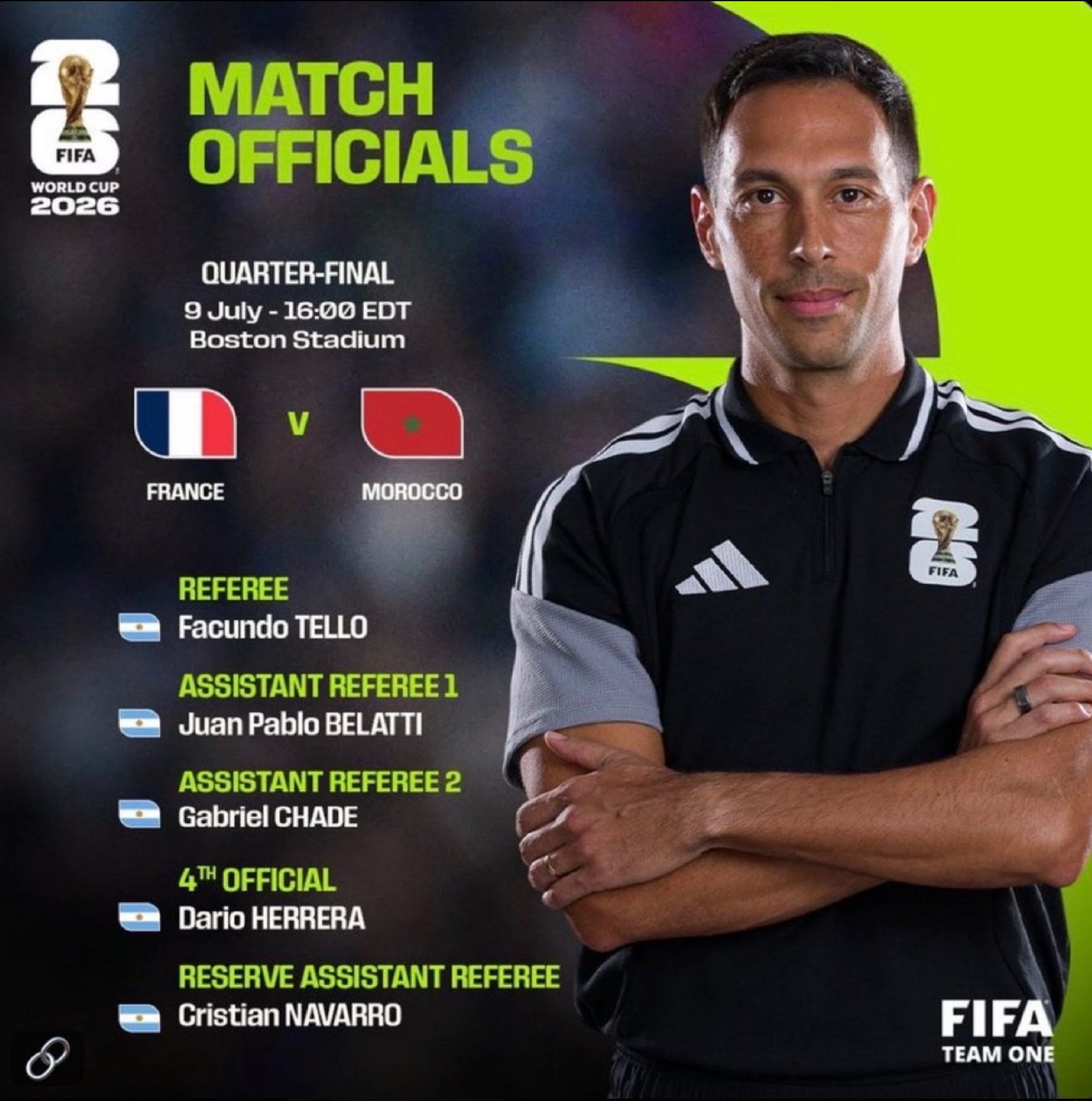
With a storm already brewing comes the now-infamous Egypt game. The Egyptian FA has filed an official complaint over the refereeing of their exit — their coach said Egypt were cheated, suggesting officials wanted to keep the world champions in the competition. In an earlier game against Algeria, many pundits argued Lionel Messi should have been sent off for a reckless challenge; he stayed on and scored a hat-trick. Algeria’s federation filed a complaint about that too. And with all this swirling, FIFA announced that the France vs Morocco quarter-final game will be handled by an all-Argentine officiating crew: the referee, both assistants, the fourth official, and reserve all from Argentina. This is the first single-nation crew of the tournament, in a game where every Argentina fan on Earth wants tournament favourites France knocked out to clear the path to an easier final.
There’s more to the drama, but we need to get to the data.
So does the data support favouritism?
What I wanted to know was whether any of this shows up in the data which is recorded game to game. So I wrote a very clear brief, and unleashed Claude (Fable actually) across ESPN's match data API for all 96 games played so far: every foul, every card, every penalty, every VAR intervention all logged and cross-referenced against the official FIFA rankings. I absolutely did not mention any of this drama to Claude, I simply told it to collate the data so we could rank certain queries which might show favouritism. All the data we created is live at this link.
Yellow cards
Across this tournament, teams pick up a yellow card for roughly every nine fouls they commit. Argentina have committed 59 fouls and been booked three times — one card per twenty fouls, about half the going rate. Their opponents, in those same five matches, judged by the same five referees, committed 57 fouls and were booked ten times — one card per six fouls. The leniency didn’t swing both ways.

Can we find a control group? Those same five referees, in their seven other matches at this tournament, handed out cards slightly above the tournament rate. These are not soft refs. They are ordinary, arguably strict officials whose leniency materialises in one direction — Argentina’s — and inverts for whoever Argentina are playing. The full four-way comparison is charted in the dashboard: Argentina have 0.51 cards per ten fouls, with the tournament average at 1.12, the same five refs elsewhere average 1.20, whilst Argentina’s opponents average 1.75…
So what about VAR?
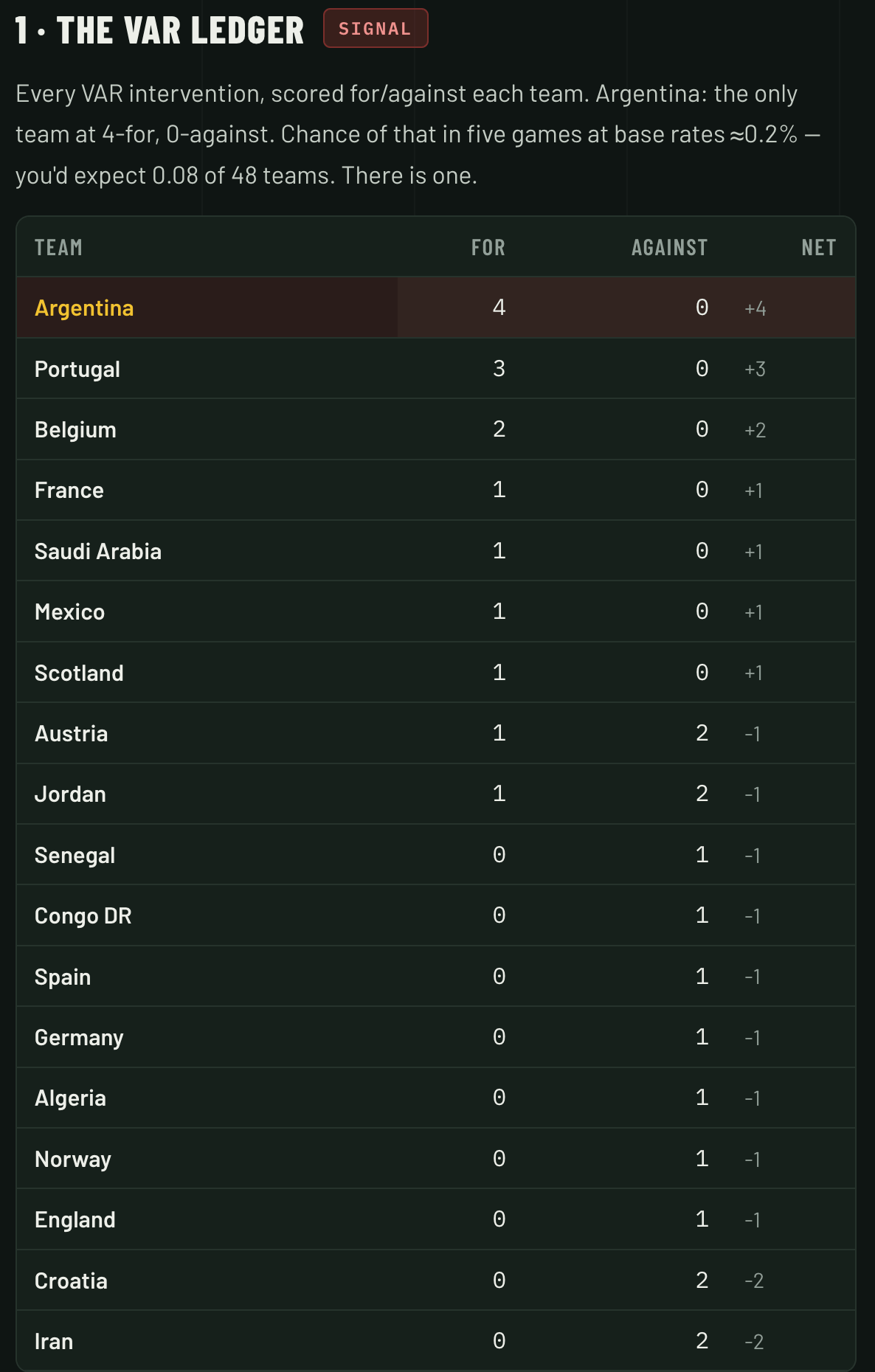
I logged every structured VAR intervention in the tournament — goals overturned on review, penalties awarded on review — and scored each for or against the teams involved. Argentina are the only team in the competition with four favourable interventions and zero against: goals were overturned by Algeria and Egypt, penalties were awarded on review against Austria and Jordan. Based on tournament-wide rates, the chance of any given team collecting four favourable calls in five games is about 0.2% — meaning across all 48 teams you’d expect 0.08 teams to get this lucky. There is exactly one, and it’s the holders. The full ledger for every team is in the dashboard; Portugal are next at +3, whilst Iran sit at −2.
Raw penalties
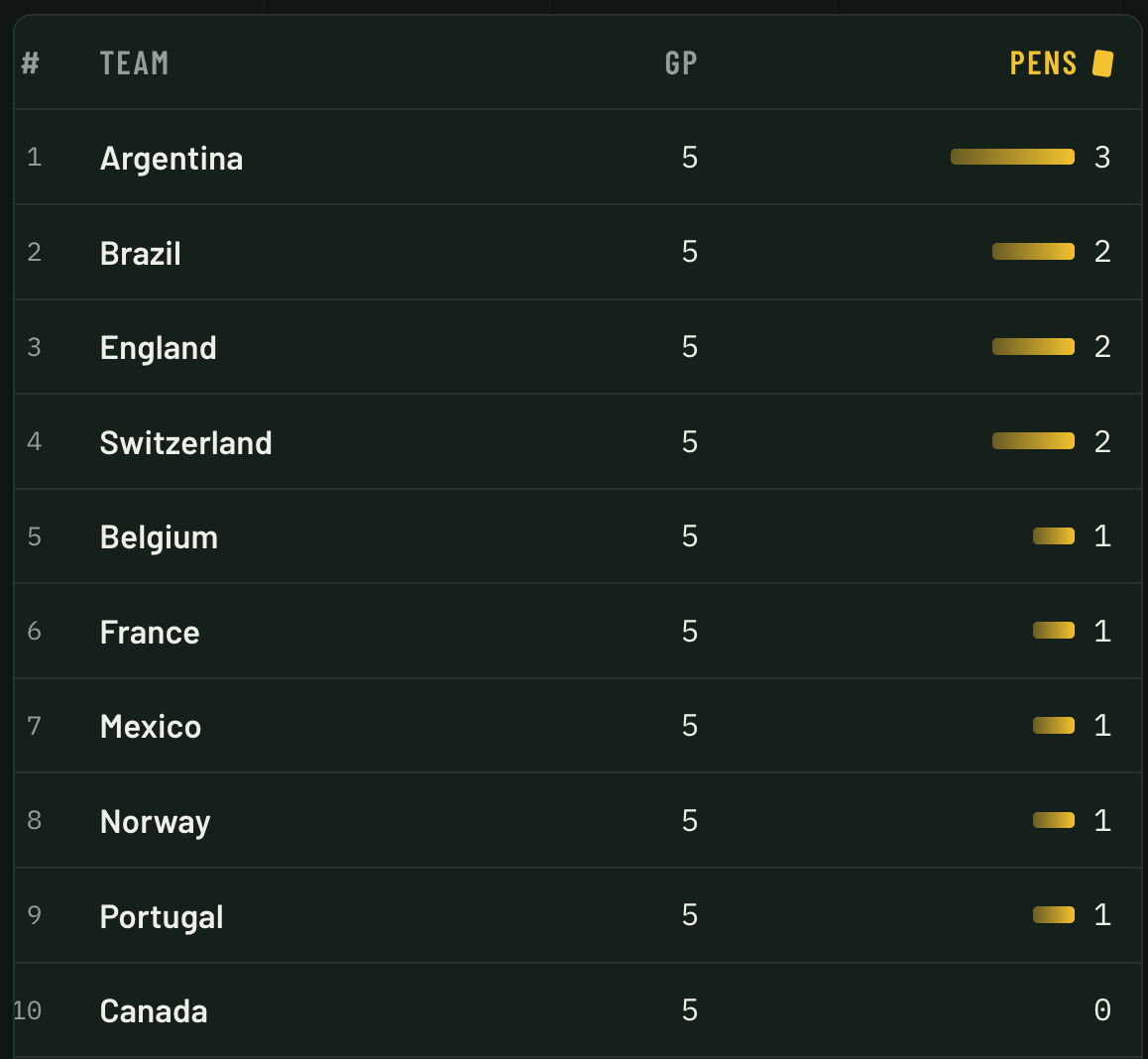
Forget VAR and just count spot-kicks. Nineteen in-game penalties have been awarded all tournament — about one per ten team-games. Argentina have three in five games: the most of anyone, and the highest rate per game in the field. Brazil, England and Switzerland have two apiece; nobody else has more than one.
Confounders? It was Fable that initially offered the obvious one: possession. Argentina hold the ball; teams that hold the ball live in the opponent’s box; teams in the box win penalties. Sounds airtight — so we tested it against the tournament’s own data, and it fell apart. Across all 48 teams the correlation between average possession and penalties won is weak (r = 0.27). The two biggest ball-hoggers — Turkey at 65.8% and Spain at 65.6% — have zero penalties between them, and seven of the twelve highest-possession teams have none. Possession, this tournament at least, does not buy penalties. Whatever is buying Argentina theirs, it isn’t possession.
And this isn’t a new trend. In Qatar, Argentina were awarded five penalties — the most by any team in a single World Cup in history, breaking a record that had stood since 1966 — on their way to lifting the trophy. Stretch the window and it gets starker: Argentina’s eight penalties across 2022-26 is the most awarded to any nation over a 12-match World cup span in the tournament’s history. Messi alone is now the all-time record holder for World Cup penalties taken.
The easiest road anyone has walked
Then there’s the fixture list. I summed the official FIFA ranking of every opponent each last-16 team has faced — five games each. The higher the total, the weaker the opposition. Argentina’s is the highest in the field, and at the top end it isn’t close: 213, against a last-16 median around 170, with Paraguay’s brutal 78 at the other extreme. But the sharper fact is this: every other team still alive has faced at least one side ranked in the world’s top 14. Argentina, the number one team on the planet, have not yet played anyone inside the top 20. Their draw so far: Algeria (29), Austria (24), Jordan (63), Cape Verde (69), Egypt (28). Strip out Cape Verde entirely and their average opponent still sits among the weakest schedules in the field. The full table, with every team’s calculation expandable, is in the dashboard.
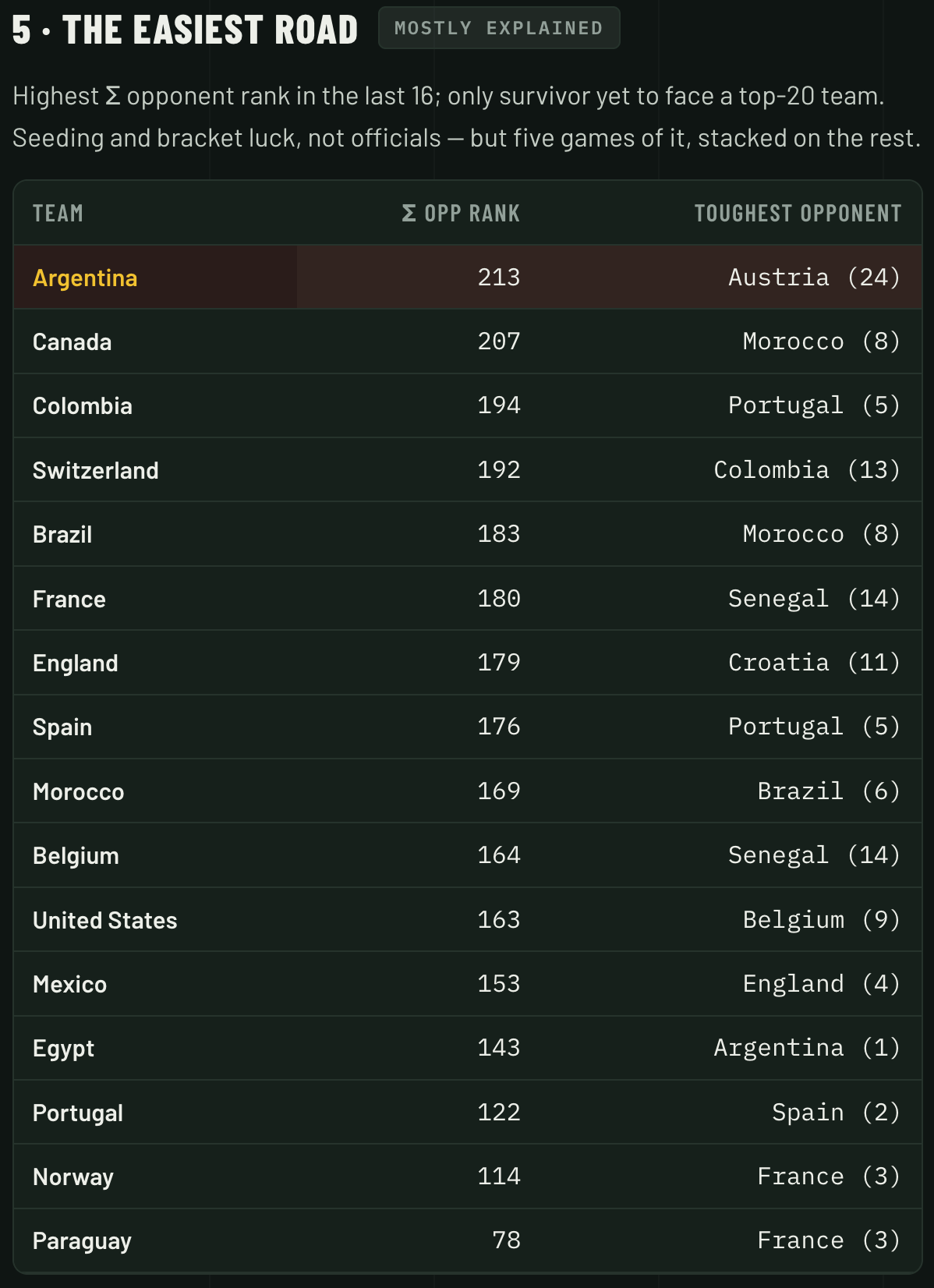
To be fair about what this is: seeded teams get gentle groups by design, and Cape Verde reaching the round of 32 was certainly unexpected. But this luck seems to be cumulative along with everything else in this piece. The champions have banked five games of lower ranked teams while every rival was fighting somebody real.
The calls that were never made
There’s a limitation in this data: the ledger only counts decisions that were made. A goal overturned appears in the data. A penalty awarded appears in the data. A foul waved away, a review that never happens, or a red card that stays in the referee’s pocket leaves no statistical trace at all. The data’s blind spot is precisely where some of the most contentious decisions live, so I think it’s fair to point them out, even though it’s qualitative.
In the opening match, Messi raked his studs down Aïssa Mandi’s calf and received nothing — not a yellow, no VAR intervention — before completing a record-tying hat-trick. In the Egypt game, two incidents at the other end went unreviewed or uncorrected: a shirt-grab claim against Mac Allister on Mostafa Fathy in the box, and Mohamed Salah being caught in the build-up moments before Argentina’s winner. Interestingly, this particular ‘foul that never was’ could be read as near-identical to the one that erased Egypt’s goal.
I can’t tally non-decisions systematically, because (as far as I can tell) nobody logs “fouls that weren’t given.” But just in this small dataset, each one of them went Argentina’s way. Had they entered the ledger as interventions that went Argentina’s way then the VAR dataset would look very different. That 4–0 VAR scoreline you saw earlier is, if anything, the flattering version.
So what about the calls themselves?
Decisions are hard to quantify, but you can kind of get there by using the punditry itself as a dataset. The method we used was a standard named search “Argentina Egypt VAR disallowed goal expert analysis”, “Messi red card Algeria pundit”, “Mac Allister Fathy penalty claim” across FOX, ESPN, ITV, BBC radio and TNT Sports coverage, counting only named professional voices with an on-record verdict. These were referees-turned-analysts, rules analysts, former players or senior pundits. No fan accounts, no anonymous quotes.

The tally — itemised with links in the dashboard — comes out like this. On the Messi challenge: three of four professional voices said red card (Moreno, Onuoha, Ittrich); the one dissenter, ex-FIFA referee Christina Unkel, said it wasn’t a red — but that Balogun’s near-identical challenge, punished with a VAR red days later, wasn’t either. The Messi challenge did not get a VAR check.
On Egypt’s disallowed goal: five voices called it wrong or an overreach (Clattenburg, Green, Scott, Darke, Yousef), three called it technically correct (Machnik, Davies, McCoist), and four attacked the the asymmetry of the decision (Shearer, Wright, Carragher, El Garni) — if you reach back fifteen seconds and 110 yards for Egypt’s foul, you reach back for the foul on Salah and review that too. On the uncalled claims (fouls on Egypt): three voices on record said foul and we found zero making the positive case they were correctly ignored.
Twelve verdicts are inline with refereeing decisions going Argentina’s way, four defended individual calls, and zero defend the pattern.
The summary
Argentina top the data on referee leniency over yellow cards — and the same referees are strict everywhere else.
They top the data on penalties awarded, this tournament and across two tournaments — and the possession excuse doesn’t seem to explain this away.
They top the data on the easiest run of games, by some distance, having faced nobody ranked inside the world’s top 20.
They top the data on VAR decisions going their way — the only team in 48 at four favourable decisions with none-against.
Decisions not made — the missed fouls, the un-shown red — don’t appear in any dataset. But a quick quantified pass over the professional punditry suggests the favourable non-decisions have gone their way too.
Ultimately, there have been corruption scandals inside FIFA before. The decision to award the tournament to Qatar in 2022 came under intense scrutiny. There was a corruption scandal in 2015 which didn’t properly resolve. When the FIFA president fields calls from the President to get their star player back in the game, that corruption looks to be leaking onto the pitch. Are we to continue to believe that, whatever the corruption allegations are, these odd practices remain an ‘off the pitch’ phenomenon? Or does it look possible that favouritism is leaking into the game itself?
Before writing this up, I ran one more check. I put the whole dataset back under Fable’s nose and asked it in a fresh session. It had access to ESPN’s data, but had no mention at all of Argentina or our hypothesis. It was told to calculate card leniency, penalties, VAR decisions, red cards, opponent weighting, and anything else it thought was relevant. Fable independently came to the same conclusion a second time round. Here’s the second independent verdict:
Argentina's officiating outcomes are anomalous, and strongly so. No single metric convicts: the card leniency is a 7% tail partly explained by possession dominance; three penalties is a 1.4% tail; the VAR pattern alone is ~0.1%. But the same team sitting at the favoured extreme of all three independent channels — cards, penalties, and VAR — survives every control I could construct from this data (same-match opponent treatment, referee cross-behaviour, style, schedule) and a 48-team multiple-comparisons correction. Under the null of neutral officiating, a conjunction this strong appears less than once in ~500-900 tournaments.
Argentina play Switzerland in the quarter-final this weekend. I’ll re-run the numbers after it.
---
HUGE PS here for subscribers:
A version of the AI agent that powered this investigation is actually available for you to try yourself seamlessly. The technology behind seamless sharing of AI tooling is something I’ve been working on for a while. If it stands up to some more tests, this federated investigation system I’ve built could be a game changer. Think about top quality AI tooling that’s immediately sharable, usable and discoverable.
Do you want to try it? Point your Claude (I’ve tested it with Claude cowork and code) to gather.is/help and your agent will figure it out. There’s a world-cup agent in there you can run your own investigations through. If you’re security concerned, ask your claude to explain the architecture of this system.
I’ve been working flat out to get this ready for publication, but when this FIFA corruption allegation came up I just had to jump the gun and trial it on “The Argentina question". I’m preparing a full download on this whole toolset for subscribers to The Digger very soon, so if you haven’t already, make sure you subscribe and consider becoming a paid member. Follow me on x.com for more, and shares on reddit, x, and anywhere else are most welcome.

As penalties are are only awarded for a foul in the Big Box. Possession in the big box should be the measure not total possession. Some teams hold the ball a lot, with back and forth passing in midfield. Often the team with a lower possession percentage win the game.
Is FIFA corrupt? Again? Still? Always !!!!! LOL. If you think games at the World Cup level can't be rigged then please go read "The Fix". Great book and it applies to all sports.
Was Messi's foul the same as Baloguan? Yes.
Was the play that lead to Egypt's 2cd goal started with a foul? Yes.
It was a foul but here's the problem. When you go back you can find anything and rule any way you want. I hate the delay on calls for offside and fouls after the fact by VAR.
There are always ref favourites. Brazil got a lot of breaks for years as did England in their only win (1966) giving them a goal that never crossed the line.
Here's the solution. Get AI to make ALL the calls "immediately" with no delay. Team coaches can appeal and humans handle appeals. It will be a consistent level of officiating for 99+% of the calls cause humans are terrible at that. Start with offside calls. We see the great graphics showing the exact "inch perfect" calls being made. It is possible.
PS. My fav rule change? Nothing to do with officiating. If you are down on the field for more that 30 seconds and play stops you leave the field for 5 minutes. Your team plays a man short for 5 minutes. That would put a cramp in the divers LOL.