


There is a specific kind of rot that happens when the people who write the rules are paid by the people who benefit from them.
For decades, we’ve been told that clinical guidelines are the “gold standard” of evidence-based medicine. But if you peel back the administrative layers of our institutions, bodies like the National Institute for Health and Care Excellence (NICE), you don’t find the pure crystalline science its champions believe it to be. Instead, you find a web of financial tethers, suppressed data, and a systemic hostility toward anything that can’t be patented, packaged, and sold.

As readers know, The Digger is investigating why our current system is failing. We shouldn’t accept a system that ignores evidence and champions profit. Our culture doesn’t need to prioritize industry interests over patient remission. Things can — and should — be run differently.
Running parallel to the investigations into Aluminium, Digger subscribers will now be the first to get investigations into the myriad of special interests shaping the treatments you’re given when you fall sick.
What we’ve known since 2005
To understand how we got here, we have to go back to 2005. The House of Commons Health Select Committee released a report titled “The Influence of the Pharmaceutical Industry.” It was a watershed moment that we, as a society, collectively decided to forget.
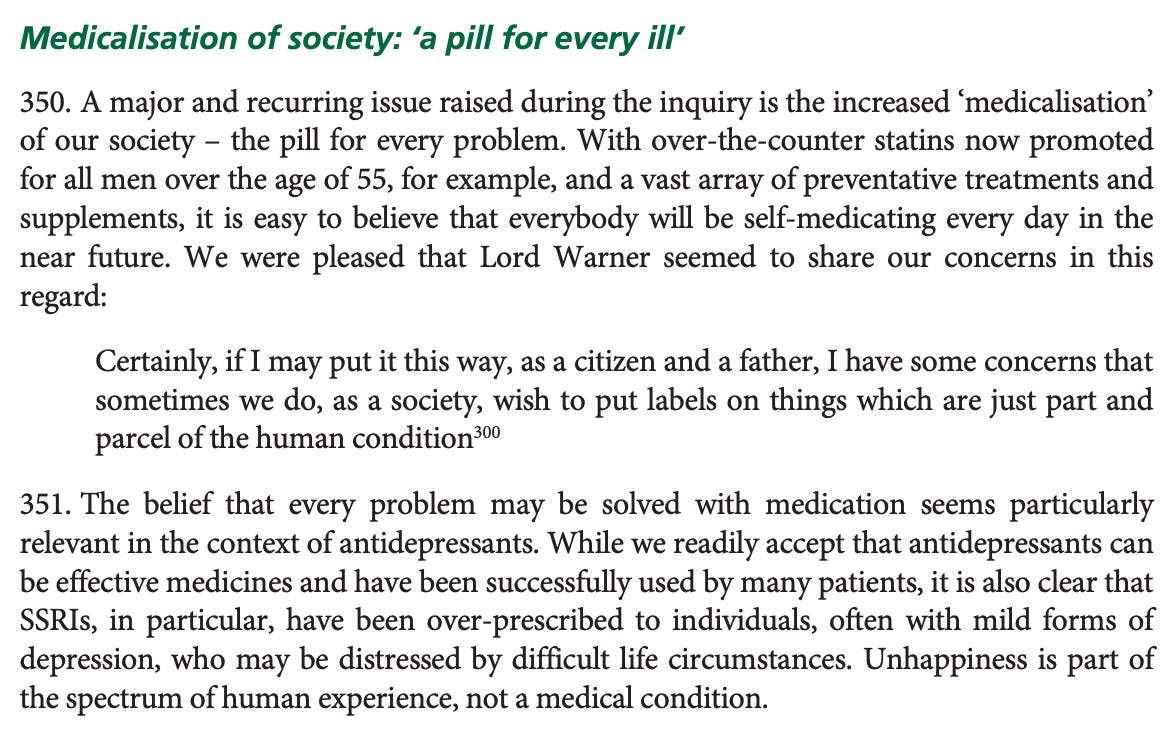
The 2005 report found that pharmaceutical giants were "medicalizing" society. The Committee was blunt: they noted that while the industry is a “jewel in the crown” of the UK economy, its interests and the public’s interests might overlap, but they are “not identical.” Those are polite words describe an industry that prioritizes its bottom line over patient care. The report identified a clear trend: The “medicalisation of society.” Health is seen through a medical and pharmaceutical lens, rather than preventative, social or lifestyle one.
“The industry has exacerbated the unhealthy reliance on medicines... categorising more and more individuals as ‘abnormal’ and in need of drug treatment.”
Fast forward to 2020, and the Cumberlege Review confirmed our worst fears. The system is “disjointed, siloed, unresponsive and defensive.” Patient concerns are routinely dismissed as “anecdotal” while industry-sponsored data is treated as gospel. The result? A culture where forty years can pass while a drug continues to be prescribed in the full knowledge that it causes birth defects.
The Case of Sodium Valproate
Sodium Valproate, a drug prescribed for epilepsy, can have devastating effects on unborn babies. According to the report, these include:
Cleft palate, spina bifida, and heart problems.
Physical facial differences and “bendy” joints.
Increased risk of language difficulties, intellectual disability, and memory problems.
Developmental difficulties that meet the criteria for Autism Spectrum Disorder or ADHD.
This isn’t a Substack blog; it’s an officially sanctioned government report linking a regulated drug to autism.
The report proves, unambiguously, that regulators knew of the potential for harm before the drug was even licensed in 1972. It was licensed anyway. What’s staggering is it continued to be prescribed well into the 2000s. Estimates suggest hundreds of babies are still being born today exposed to the drug, despite the birth defect risk being undisputed.
Patient 1:“I was never given any warnings… my son has autism, general learning difficulties, hypotonia, dysplasia, hyper extendable joints, poor eye sight, speech and language disorder, pain in joints, no sense of danger, no life skills, poor co-ordination, gross and fine motor skills disabilities… my son will never be able to leave home and lead a normal life.”
Patient 2: “If I had known what I was doing when I was taking the drug, then I would not of brought my children into the world simply because they are so, so unhappy and they will never be o.k.”
Why the Truth Needs a Subscription
Investigations like this aren’t funded by pharmaceutical grants or government subsidies. In fact, the very institutions we investigate are the ones funding the “approved” narratives you see in the mainstream press.
When the people writing the rules are paid by the people who benefit from them, the truth becomes a liability. Independent journalism is the antidote. The Digger exists because of you. Your support allows us to spend weeks digging through 500-page government reports, following the money trails that lead to NICE, and giving a voice to the patients the system has ignored for forty years.
The Hidden Web: Following the Money
Why does the system persist in such a pigheaded manner? In ‘the medical freedom’ movement, this debate still rages. Some believe these harms are indifferent or even deliberate — that creating a chronic market of sick people via botched interventions is a business strategy.
I am closer to the systems camp. I believe two main incentives shape our discourse: prestige and money.
The timeline on Sodium Valproate practically drips with ego. Knowing the drug caused defects, one sub-committee suggested doctors should be informed without creating undue alarm.” The instinct was not to rock the boat. People have reputations to protect. If a doctor has prescribed a harmful drug for years, their ego often cannot bear the truth. They would rather minimize the failure than admit it.
The other great motivator is of course money. Readers of The Digger will know that money is everywhere. Not only does it pollute the process by which drugs are recommended, it pollutes the democratic process by which patients request them. “All-Party Parliamentary Groups” are supposed to be non-partisan forums for citizens to engage parliament.
Researchers identified 146 citizen health groups; of these, 58 (39.7%) received a total of £2,197,400.8 from pharmaceutical companies. Most of that money was funnelled into groups focused on Cancer and Health. The “citizen” groups asking parliament for access to new drugs are often funded by the companies making those drugs. It is a perfect loop; industry lobbies government to open up access, then influences the regulators and NICE to hurry those drugs to the frontline.
A systematic review found that 45% of guideline authors in America had at least one financial conflict of interest. In the European Society of Cardiology, that number hits a staggering 80%.
The loop means effective treatments can be buried whilst novel pharmaceutical ones are promoted. It doesn’t really matter how well those drugs work, and the system remains indifferent to them being safe; the Cumberlege Review makes that clear. The north star is profit, and much of what’s downstream of that is polluted.
Getting this fixed requires the public to know that we have a huge problem. Even the government know we have a problem but the public remain in the dark. That will be the purpose of the NICE files, to shed light on these issues.
Case Study: The Diabetes Escalator
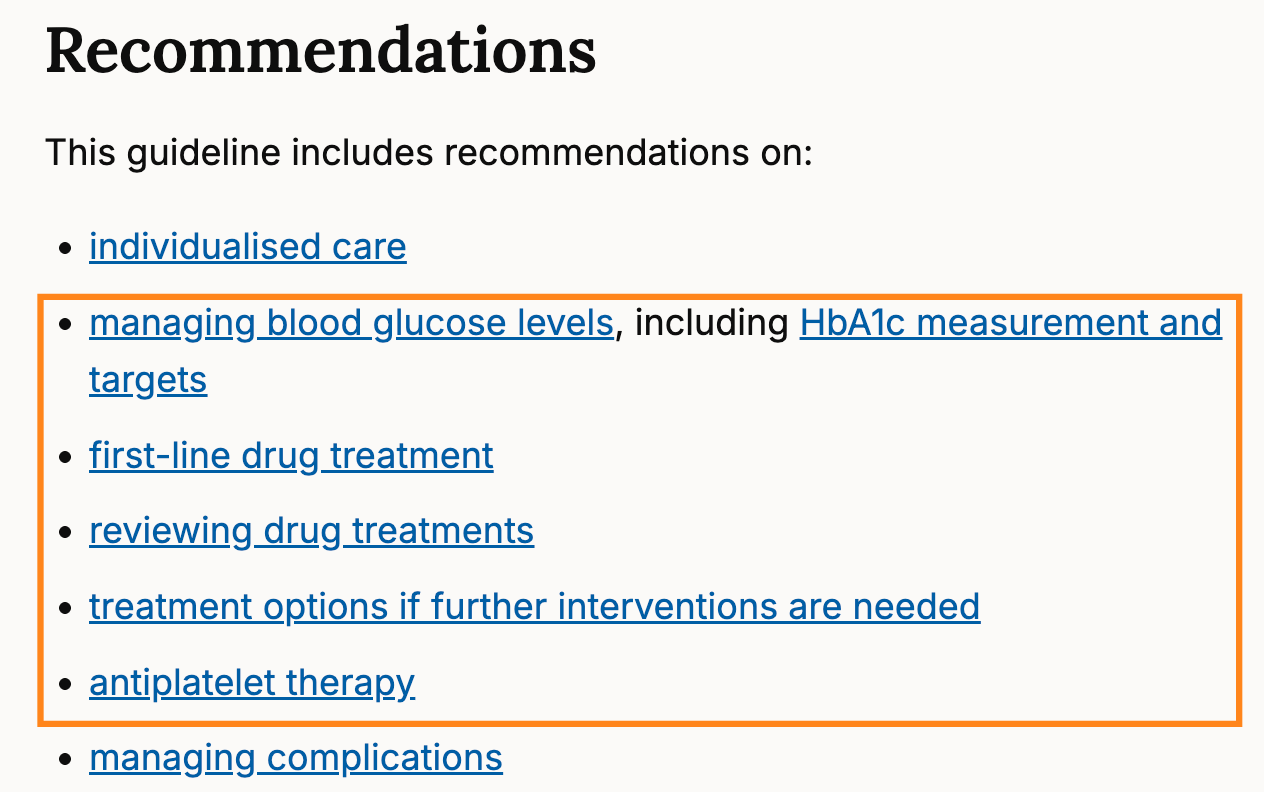
The official NICE guideline (NG28) reads like a sales brochure. It’s an “escalator” model: you start with one drug, then move to two, then eventually, the needle.
But Dr. David Unwin, a GP in Southport, has proven this progressive narrative is a lie. One day he had an epiphany. A patient who had ignored her metformin prescription returned having lost 19kg; she had put her condition into remissions via a low-carb diet.
Stunned, he measured her blood sugar, and sure enough it was within the normal range. She had achieved drug-free remission from type 2 diabetes.
“She’d done something I didn’t know was possible. I had always seen type 2 diabetes as a chronic, deteriorating condition requiring medication and shown no curiosity about the true cause of chronic illness. I felt as if I’d been sleepwalking.”
Dr Unwin he started low-carb support groups for his roster of diabetes patients who hadn’t improved in years. Sure enough, one by one, they all began to lose weight and reverse their condition. Older patients who’d been dumped onto the drug escalator were finally losing weight and coming off their drugs. His intervention cost close to nothing, and it was saving his practice £68,000 a year.
By ignoring the NICE guideline on recommending “starchy carbs”, Unwin had achieved a 51% drug-free remission rate across his entire cohort. For those in their first year of diagnosis, the rate was 77%. For those patients following for two years, this reached a staggering 91%. This is simply astonishing for a disease that’s considered to be chronic and progressive.
The response from the regulator? In 2020, NICE revoked its endorsement of Dr. Unwin’s “Sugar Infographics” — simple charts showing that a bowl of rice is the glycaemic equivalent of 10 teaspoons of sugar. Even stranger, they were bullied into doing so by shady lobbying tactics.
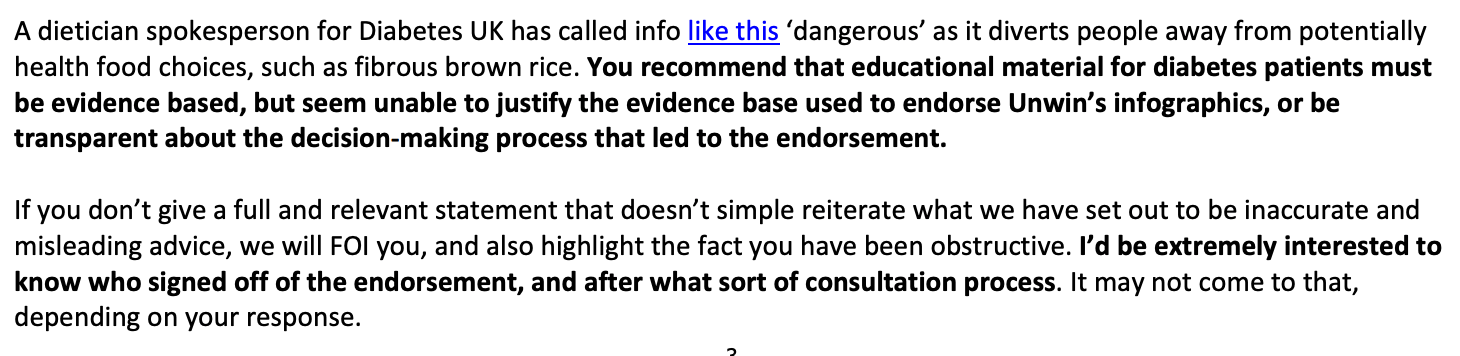
NICE administrators received threatening emails from the a charity with a supposed interest in curing Diabetes. Diabetes UK wanted people back on the very brown rice that Dr Unwin had proven was raising his patients’ blood sugar! Clearly, the rot runs very deep, something we’ll be investigating in this series.
It is no surprise that Dr. Unwin — once named NHS Innovator of the Year, has made zero impact on the NICE guidelines. They still recommend a high-carb diet and a litany of expensive drugs.
More to come.