


You may have heard the term “singularity” recently. Perhaps you heard it earlier in the century when it was popularised by Ray Kurzweil in his 2005 book “The Singularity is Near”
It’s hard to overstate how unseriously people took Kurzweil’s ideas at the time. Reading it in 2010, I was open to his ideas, but they read like a Science Fiction novel rather than a sober assessment of our future. I couldn’t fault the arguments being made, but the conclusions were... weird.
Kurzweil argued that by 2036 - absent some disastrous calamity - technology would be evolving at such an incredible pace that humanity wouldn’t be capable of keeping up with it. Humanity, earth, existence, would go through something he calls a singularity. This is something that happens in the universe, where all mathematical, statistical, reasoned and scientific predictions about what happens become useless. It’s an event of some kind, that’s driven by exponential change. It’s so rapid, so weird and so consuming that we are forced to use our imagination to see it because our reasoning tools fail us. In my imagination, the singularity is an event where human and technological consciousness merge with the fabric of the universe.
Like I said... it’s weird.
These are ideas about technology that border on the religious. It has hallmarks of ascendance, returning to spirit, and an afterlife beyond the physical realms. Life, so it goes, can continue on in the universe indefinitely and merge with the fabric of space and time. Whilst these are religious ideas, don’t let that distract you from the uncannily accurate mathematical modelling that sits underneath Kurzweil’s reasoning. He has an incredible track record of making accurate predictions, even if they do sound mad.
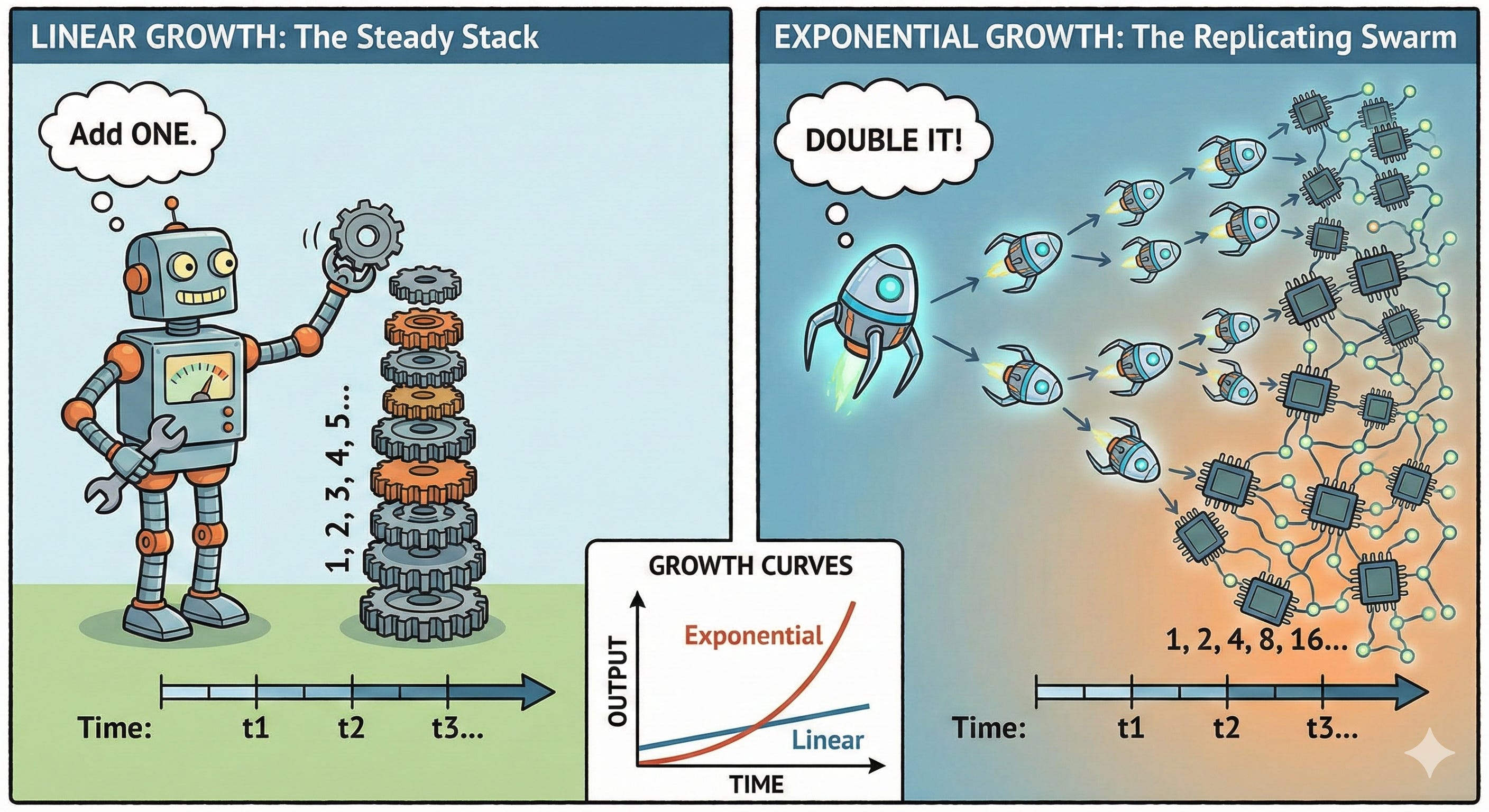
Kurzweil notes that technological progress is not linear, it’s exponential, because it ‘feeds’ on previous innovations. Imagine bacteria or algae multiplying in a pond. Their growth rate is a function of their current number, because each bacteria doubles itself. Therefore it’s obvious, if there are more bacteria, there’s more doubling potential each time they grow. Their current colony size determines their current growth.
Bigger → faster → weirder.
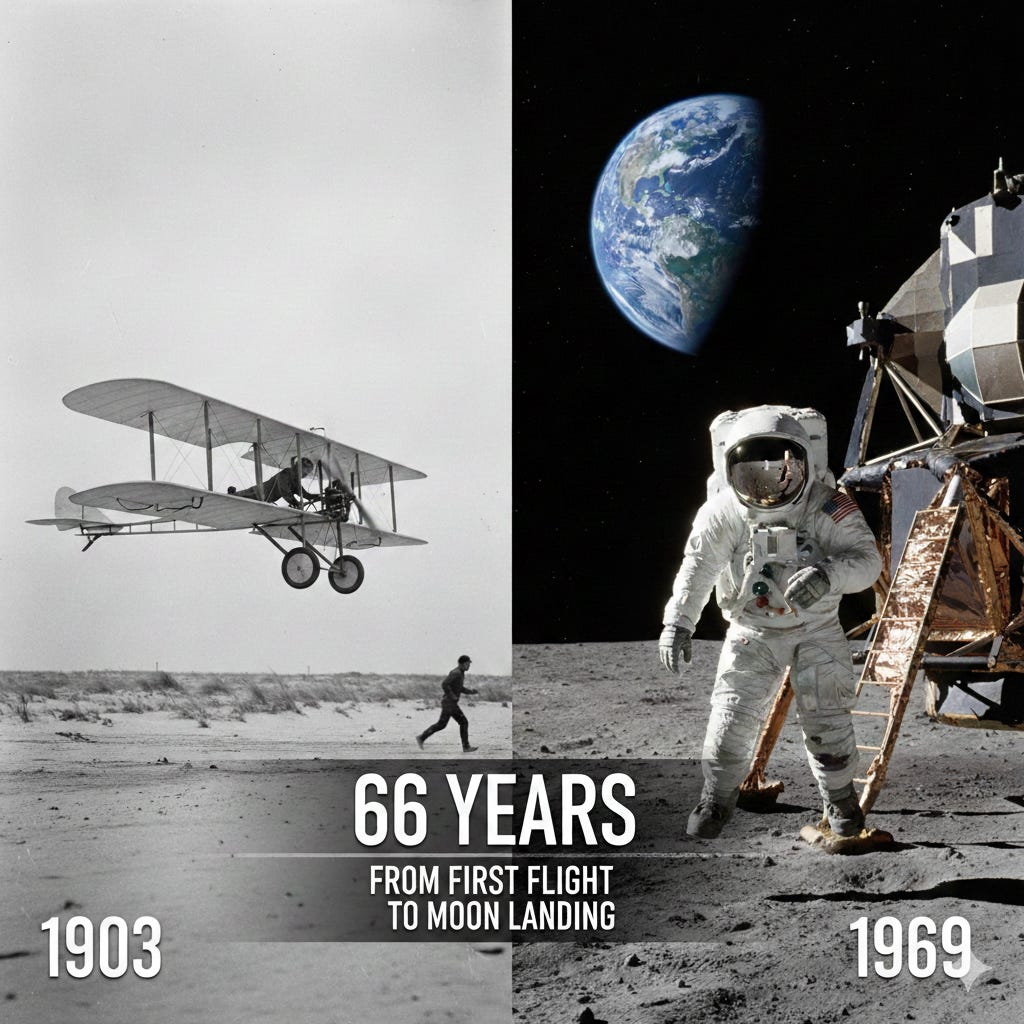
Well, technology is behaving in the same way. Its growth tends to catch humans off guard because at first it moves with a lethargic roll but there comes a time when it accelerates rapidly. All of human history (so we believe...) humanity existed without the power of flight, then suddenly it arrives in 1903. Just 66 years later, humanity had landed on the Moon. No flight → space flight → moon landing.
This is what Kurzweil calls ‘The Law of Accelerating Returns’. That technology’s progress accelerates future technological progress. It feeds itself. A self stimulating feedback loop where things get weird. The famous examples are worth recounting. In 1971, Intel delivered the first commercially produced microprocessor, it had 2,300 transistors on it. By 1989, there were 1.18 million transistors. In 2000, there were 42 million, and by 2020, Apple announced the M1 chip with 16 billion transistors.
Do you see that jump? 42 million to 16 billion in 20 years. Just five years later, in 2025, Nvidia’s GeForce 5090 announced a chip with 92.2 billion transistors on it. It’s worth dwelling on this, because the numbers are so unintuitive. By 2020, we had multiplied - not grown, we had multiplied - the number of transistors on a chip by a factor 7 million since they were first commercialised in 1971. Now consider this: five years on from Mac M1, we multiplied that entire ‘from the beginning of time’ historical progress five more times. Every two years, we are doubling the amount of computing power which had previously taken all of human history to build.
Intuitively understanding what this means is hard because exponential acceleration is notoriously difficult to imagine. The classic way to understand it is to imagine a hockey stick growth pattern. Consider the graph below; as time moves forward, technology feels like it’s growing in a linear fashion - steady, stable, predictable. This is the ‘flat’ part of the growth curve, which happens because you’re starting a brand new growth cycle from scratch. Then suddenly, the growth compounds rapidly and you get this near vertical acceleration.
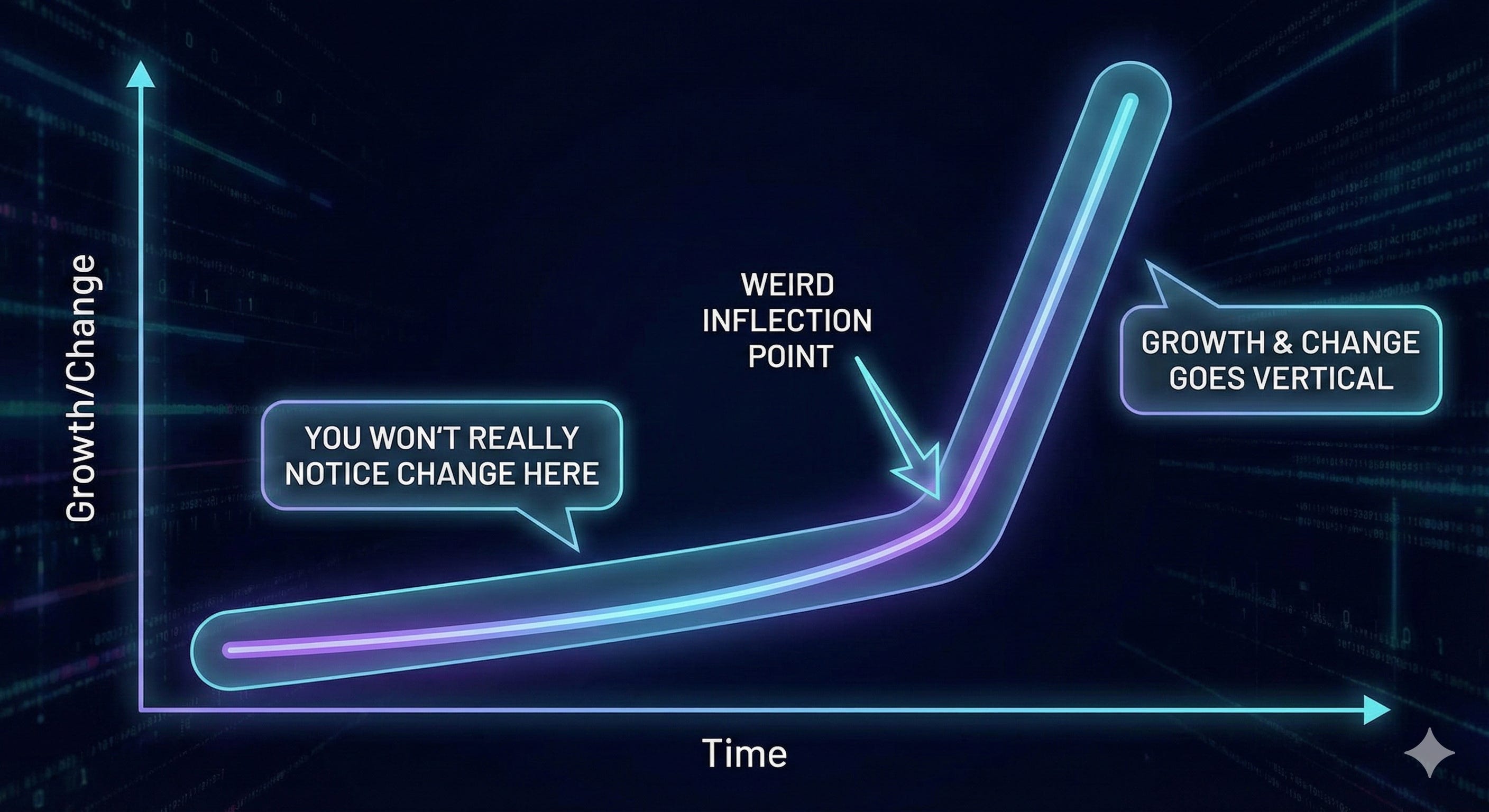
I’ve always found the hockey stick analogy too lifeless to follow... so try this instead. Imagine trying to move a huge round boulder from its initial state of inertia. It takes a lot of effort! You’d sweat a little as you try to leverage the rock forward with levers of wood. As you try to roll the boulder forwards, the first part of your mission is slow and laborious. You finally get it moving, and you might not notice the boulder’s momentum is seriously increasing until you reach the inflection point. This is the moment you finally nudge the boulder over the lip of a gentle slope. Suddenly it’s moving under its own steam. Momentum takes over as the real driver of its acceleration. It’s effortless now, and it seems to be moving itself.
After that boulder rolls over the edge, it crosses the so called inflection point. It now accelerates very quickly. The rate of change, relative to its sluggish start, goes vertical. Now imagine your emotional human state when this happens in real life. You’ve just (carelessly) pushed a boulder over the lip of a hill. It was so slow! But now you now see it accelerating, rocketing down the hillside with a terrifying power. Your heart rate goes stratospheric. Adrenaline pumps into your blood. Your palms sweat. Your inner dialogue screams how stupid it was to push the boulder over the hill. You’ve lost control of the rock! Is anyone at the bottom!? Will it ever stop!?
This is exactly where humanity now finds itself with AI.
We’re living through the ‘lip of a hill’ moment. We’re at the inflection point right now on the tail end of a 50 year exponential slog that brought us to this point. Each two years that now passes, we’ll double the processing capacity of the previous 50. When you consider that “self improving AI” is the context in which this is all happening, things are about to get very weird.
Not only did Kurzweil predict this moment all the way back in 2005, he even predicted the date it would happen. How could he have been so accurate 20 years prior? Because Kurzweil understands the weirdness of exponential growth, it is his gift. He intuitively understands the law of accelerating returns. It means he can accurately predict how much computing power we are going to have and what that computing power will be able to achieve.
In 2005, Kurzweil predicted “we will have effective software models of human intelligence by the mid-2020s”, people thought that was crazy but he was right. He predicted computers would pass the Turing Test in the 2020s, he was right. He predicted that “By the 2020s nanobot technology will be viable, and brain scanning will be one of its prominent applications”, again, he was right. He predicted we’d have nanobot brain interfaces by the 2020s, he was right. He was right about the resolution of brain models we’d have by the 2020s too. So when he tells us we’re about to go through a period of change so rapid that the only way we’ll make sense of it is to biologically integrate with AI, we’ve good reason to believe he’s correct.
He invented reading machines long before the technology to power them was real. He did the same with musical synthesisers. The method is simple enough to state, but it’s hard to execute; observe where computational power is going, then consider the impact of where it will be. Don’t invent with ‘now’, invent with ‘soon’. It’s smart, it has been proven effective, and it’s highly relevant to the moment we find ourselves in.
We must stop thinking about where things are right now and instead look towards a rapidly moving horizon. Not only will we have to get used to rapid change, we will have to master how to live with rapid and accelerating change.
Let’s look at one such example: India’s infamous technology and IT outsourcing business. The $283-billion-a-year sector makes up about 10% of India’s GDP. This is a significant globally relevant industry. Until recently, the sector was projected to grow to $350 billion by the end of 2026. However, the share prices of the companies who have traditionally benefited from this boom are in the process of nosediving.
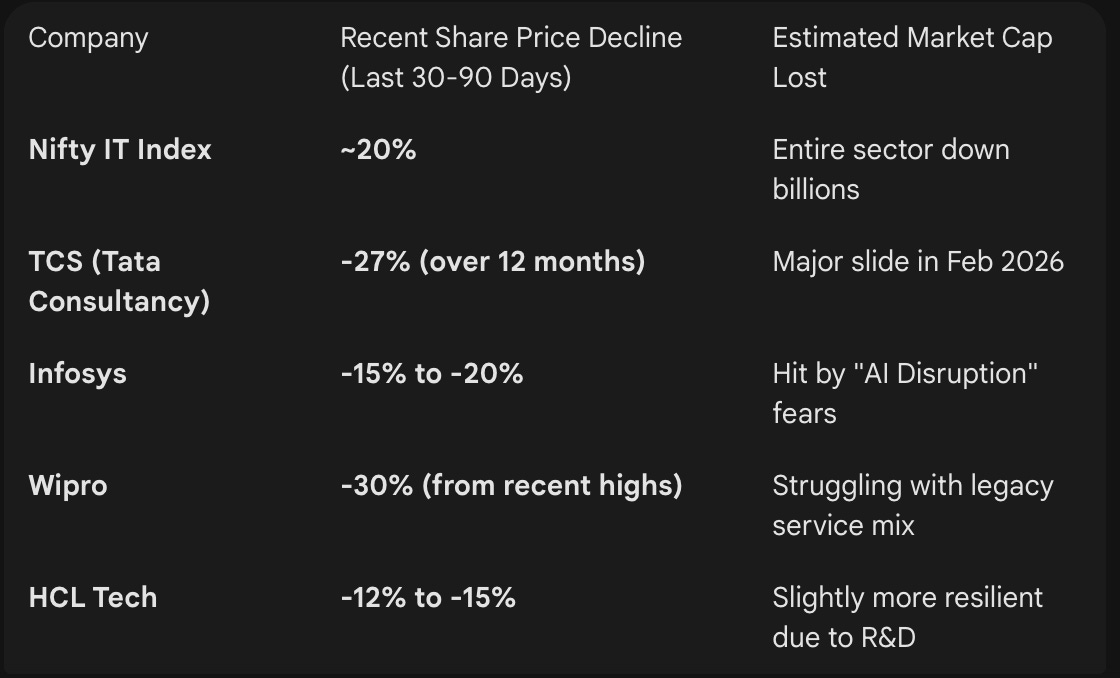
Why? Because low Indian wages can’t compete with the rapidly declining costs of AI coding agents. The pace of AI has caught even the technology sector off guard. Fully autonomous AI agents can read your codebase and build whatever you ask in natural language. They’ve become so good that many advanced devs are shipping 100% of their code directly from the AI agent. Spotify’s developers “haven’t written any code since December 2025”.
In a lot of cases, the devs don’t even read the code before it’s shipped into production. It’s hard to overstate how big of a deal this is. Imagine a building being constructed from blueprints that come straight out of an AI. A plane manufactured from designs right out of an AI agent. That world is absolutely on the way, not in some distant Sci Fi future, but now. So what’s the cost for this superpower?
It’s just $90 to $100 per month per developer.
Why will American and European companies outsource to India if they can now get ‘a coding partner’ even cheaper from the AI companies? The market is betting this is going to become a big problem for the Indian IT sector. Contractors are asking for 20-30% discounts on delivery, and with very little room left for Indian workers to soak up lower wages, it’s leading to job losses.
As all of this plays out, the exponential acceleration, the ‘boulder down the hill’ pace, it’s catching people off guard. It’s doesn’t matter which segment of the economy you’re working on, people just don’t ‘get’ this pace of change. We are stuck in the shadow of 10,000 years of linear thinking; progress is slow and steady... but suddenly it’s not.
Take this fairly typical example in which a developer argues that writing code with AI is expensive, and so he assumes it will remain expensive. It’s just flatly wrong, he’s making that same fatal error, looking at what he’s spending today and assuming he’ll be spending the same tomorrow. He thinks coding agents are expensive, but doesn’t realise that the marginal cost of writing code with AI is going to drop to the cost of the electricity. Read that again and understand it; the marginal cost of AI written code will drop to the cost of electricity.


How can that possibly be? If the cost of AI drops that far, the biggest AI companies could go bankrupt? This now a highly plausible scenario given what we’re seeing. There are two things driving it: the rapid arrival of open source AI models, and a buoyant community of developers who are making those models run on consumer grade hardware. Both of them are downstream of the same runaway train: technological developments which accelerate further technological developments.
It’s worth really understanding this one part of the inflection point because once you see it, you’ll have a sense of the scale of change that’s now roaring through our society.
Anthropic, OpenAI and Gemini have spent literally tens of billions of dollars training frontier AI models. The only way they can recoup is to put those models behind a gate and make you pay for access. The costs are coming down, but they’re still relatively high right now. You might pay $5 per million ‘tokens’ of input, and a ‘token’ is basically one syllable. So by asking “Hey Mr SuperComputer, how are you?”, it would cost maybe 12 tokens. When the AI answers, you’ll pay $20 per million output tokens.
It’s not cheap. The reason?
These companies a) have capex to recoup from the billions they invested training the models, and b) must pay to run the models with the latest and most expensive processors. The Nvidia processor powering most of it is called the Blackwell B200, it has 208 billion transistors and it costs about $2.5 million per rack. They’re being bought and installed at eye watering rates. This alone has driven the insane rise on Nvidia’s share price. Does the graph’s hockey stick shape seem familiar?!
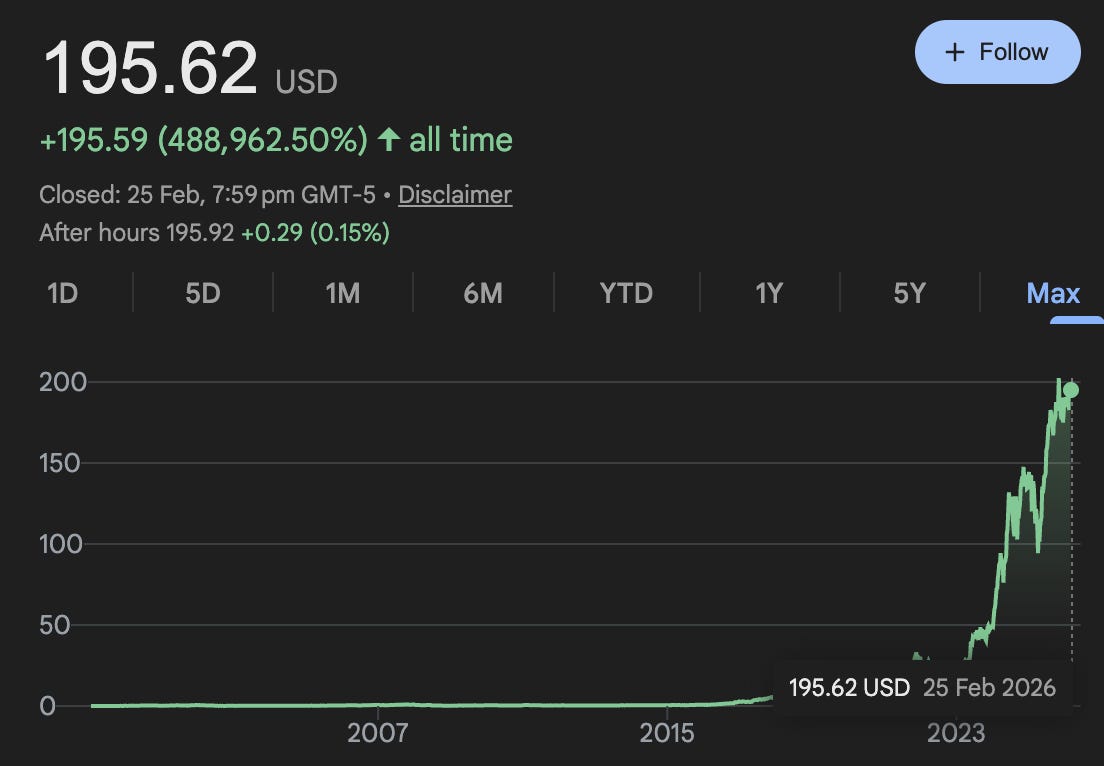
It’s difficult to plan for capex expenditure, but when you then throw in exponential change, it apparently becomes an impossible task. These companies have made decisions about the future which do not account for exponential change in their own industry. As such, they may have backed themselves into a corner. Why? Because Chinese AI companies are currently training AI models for a fraction of the cost. They’re doing so by utilising the very models Claude, OpenAI and Gemini spent billions training. Chinese AI engineers are using technological developments (Claude) to massively accelerate further technological developments. The Law of Accelerating Returns in action right under your nose.
Not only are they making AI cheaper, faster and more efficient, they are releasing their AI creations under open source licenses.
2019 no AI → 2023 expensive AI → 2026 free AI.
When I say open source, what I mean is, you can download the entire AI model and do whatever you want with it. Again, it’s hard to overstate what a massive deal this is. It’s like releasing the plans for an F22 Raptor onto the internet. Compare this scenario to Anthropic or OpenAI; their best models must sit behind a gate and access must remain pay to play. If not, they can’t recoup their massive capex costs. You don’t get to ‘see’ the model, you don’t get to hack it, change it, slice it up. Between you and the AI is a premium rate phone number. It’s a near perfect example of the whole argument I’m making: technological progress accelerates future technological progress. The arrival of AI models has made future AI models significantly easier to make!
Because of what China is doing, just dropping superintelligent models onto the internet like it’s nothing, developers can, and are, rapidly working out how to get them running on consumer grade hardware. Again, this is a huge development. Again, how do you think these indie developers are tackling this incredibly difficult problem of running massive AI computations on consumer grade hardware? They’re getting Claude, OpenAI and Gemini to help them! Do you see it in action now? Everywhere you look, technological progress is feeding technological progress in a catalytic feedback loop.
These free and open source models absolutely can compete with ‘the very best’ models and once they’re loaded onto your machine, there’s no pay to play premium rate phone number to access them. Extrapolate this trend outwards and it becomes absolutely obvious; the marginal costs of running AI will drop to the cost of electricity. AI is going to become essentially free.


What’s fascinating about this is how well it sits with the idea of a singularity. A key pillar of the theory is that normal sensemaking tools start to break down as the singularity bites. Isn’t that what’s happening here? Tech titans are forced to make the biggest bets of the millenium, but the future is almost impossible to predict. The best outcome for their massive capital outlay is they continue to make breakthrough after breakthrough, keeping their models perpetually at the cutting desirable edge.
It’s a very big ‘if' to bet on because economics is a powerful force. ‘Free’ is inescapable. If people can download a free specialised AI model for their work and run it on their laptop, then advanced AI models will have to be very special to drag people away.
There’s another theory which can explain the huge AI bets but I’ll have to return to it in future posts. In short, some people see the singularity as a winner takes all moment. If they can “get” artificial general intelligence before everyone else, whatever the cost, they’ll secure themselves into some kind of post human demigod settlement. This requires more attention than a single paragraph... But I mention it because it’s an extreme vision of one of the key ideas that emerge from singularity philosophy: the K-shaped economy.
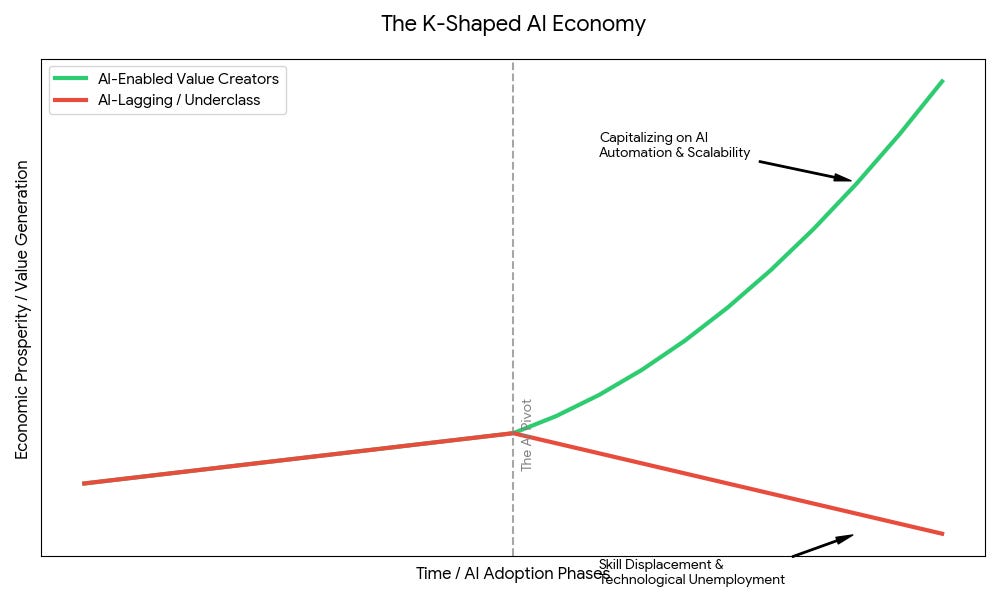
Grounding his weird ‘super fast technological upgrade’ into our actual culture, Kurzweil argues that a k shape “like” division would appear in society. Some humans would go with this rapid change, merging with the technology at every new junction. Breakneck economics would mean they’d need a biological AI interface just to keep up with the rapidly accelerating AI economy. Whilst some humans would ‘go with it’, others will reject the changing world and reject the technology entirely. Others have pointed out this will create a K-shaped split, where one segment ascends to great riches, and another becomes...well, that’s probably for another post. In any case, the change divergence could be deep enough that it transcends economics and becomes a pathway to different species of human. I know that sounds mad, but in the absence of some calamity to derail it all, it’s a plausible outcome.
As I write this, Jack Dorsey, formerly of Twitter, announced he’s cutting loose 40% of his staff precisely because of this new AI technology. The market absolutely loved the announcement. We are now in a period of history with absolutely no precedent. Making sense of what’s happening will become very difficult, but here on The Digger, I’ll continue to do my best.
From one Phil to another, Moore’s Law. It was from the mid 1960s. Take a look.
Kurzweil was well known to us in the 1980s. My colleagues at Carnegie Mellon and I created the Center for Art and Technology early that decade. Kurzweil’s music synthesizer(s) were especially important to the electronic music dimension of that group. That was led by Roger Dannenberg whose training was in electrical engineering and the rapidly developing computer science. His lifelong love remains music. When my thinking got too soft, Roger pulled out the “Moore’s Law” mallet and beat me over the head with it. Exponential growth was indeed known. It was the wave that we surfed.
Too bad you weren’t along for the ride. You would have enjoyed it. We would have enjoyed you. Actually I can use the present tense. I appreciate and enjoy your work.
This is like Feb, 2020. Everybody had heard of the Covid virus. Most knew it was likely to sweep the world. And yet few did anything to prepare for it. Humans have a hard time grasping the change that they can see coming at them is really coming.
The difference this time is that the disruption, caused by the AI "virus", won't stop.
It is getting hard to keep up. I got multiple applications I'm working on using Claude Code, and I haven't bothered looking at the code of any of them. But I keep getting more ideas. And not enough time in the day to handle it all.
Right now, Claude Code has it's limits. I had it work on a 3D file conversion program and it got stuck. I had it create a 3D viewer that it could control so it could see what mistakes there were and it could then do the full software cycle autonomously. Even so, it sat there for many hours getting nowhere. So then I told it, just use some already available open source conversion code. And in minutes it had the converter working.
In that case, it needed some help. But how many months will it be till it can write the equivalent of that open source conversion code - something that took a bunch of developers twenty years to perfect?
I see your AI agent has been working every day on Gather. What's the update on that? What milestones have you reached with it?