


To uncover how medical research really works, I’m building a database which I’m calling the “Map of Distortion.” The database links together publicly available data on which people, institutions and companies are receiving money from pharmaceutical companies and their proxies. As that data gets indexed and organised, it produces high resolution insights about how that money shapes our healthcare and medicine.
As I collate it, it becomes obvious that we have a very serious problem, because the scale at which this is happening becomes much clearer. The aim is to present the data in an intuitive and interactive map format which will make the distorting power of pharmaceutical money easy for anyone to understand. Interested? Then follow along on this substack, and please support the project with a paid subscription.
Just over a week into the project, and the data is churning up all kinds of interesting insights and discoveries. One discovery arrived after I brought the UK’s “NICE guidelines”, and a huge set of the committee notes into the database. Before we get into what I found, let’s see why NICE itself is so important.
“NICE” is the National Institute for Health and Care Excellence, and their role is to create the treatment guidelines healthcare providers rely on. These guidelines determine what treatment you’ll receive if you fall sick, so it’s very influential. In fact, it’s not just the UK where these guidelines have a major impact. NICE is respected as a global authority on treatment guidelines, research suggests at least 12 other nations take a very strong steer from their recommendations.
As well as treatment guidelines, NICE also assess new drugs looking for their big break into the NHS purchasing pipeline. When a pharmaceutical company brings a promising new drug to the UK — like a weight-loss injection — one of the most consequential decisions about its future is made by NICE “Technology Appraisal Committees.” These committees decide if the NHS should make the treatment or device available on the NHS.
In the UK, these recommendations carry serious legal weight because “The NHS is legally obliged to fund and resource medicines and other treatments recommended by NICE's technology appraisals...and must make it available, normally within three months.”
Because this pathway guarantees the NHS will fund a drug, it’s a pathway that needs to be carefully policed. To keep tabs on things, NICE describes the technology appraisals as an “independent standing committee that produces recommendations.”
Independent.
Their positioning suggests the committees are independent doctors ‘fighting in the corner’ of the NHS. But is that true? Well the Map of Distortion project is starting to shed light on this very question.
NICE publish meeting minutes, panel members, and occasionally conflicts of interest at each panel meeting. It’s something, but its a sprawling mess of unstructured PDFs across years and years of meetings. To boot? It’s not always complete. It could do with an update for 2026, so I built some scraping agents to clean it all up. Is it possible to parse all of it into a searchable indexed database?
Yes. Yes it is.
The Map of Distortion now shows there are 88 people who sit on those committees. NICE don’t formally record conflicts of interest for them, which I think is an oversight. Instead, any conflicts of interest are recorded ad-hoc at the meeting level, only if it’s deemed relevant. It means there isn’t a single place where the public can check the commercial interests of the people bringing pharmaceutical products into the NHS. I think its in the public interest to correct that.
But how?
I’ve built a range of tools that check for conflicts of interest across public datasets. Because conflicts of interest are recorded like a roll call in the meeting itself, the first check reads the NICE notes themselves and looks for any declarations there. The second check runs the name against six years of Disclosure UK disclosures, another key part of The Map of Distortion which I’ll write more on in the future. The third check looks the names up on OpenAlex and Europe PMC and then disambiguates declared conflicts of interest in any research publications. Finally (for now) a fourth and fifth check runs a query against Companies House and then the web for their involvement as paid consultants or directors of companies relevant to the pharmaceutical industry.
After running the committee through these tools, it turns out that 58% of them carry an industry tie disclosed to Disclosure UK, NICE, or in their own published research, or they are employed in a pharma-facing firm or consultancy. Depending on how you slice the data, these industry ties could be anywhere from 48% to 70%.
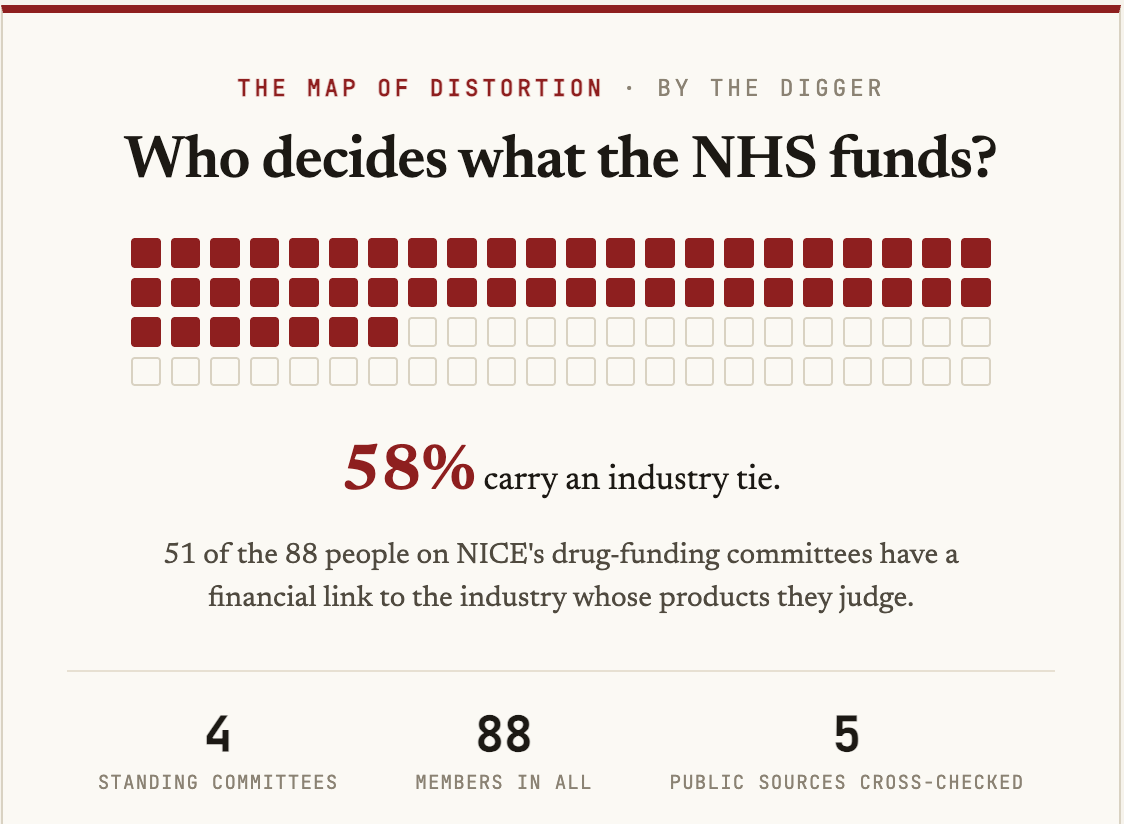
These ‘sleeper cell’ people were some of the most interesting finds. These are committee members, supposedly independent and fighting the corner of patients, who quietly moonlight as consultants in companies that take pharma money to fast track drugs through the regulatory process! Could there be a greater conflict of interest than to be on a NICE technology committee and be working for a company that sells regulatory consultancy work to pharma companies?
To be fair, many of these conflicts of interest were declared. In fact, there’s an entire story I will write about how NICE deal with conflicts of interest, do they even matter to NICE? In any case, the Map of Distortion found that in a few cases, committee members are actually company directors for consultancy firms helping pharma steer drugs through the regulatory process and they had not declared that, or NICE had failed to pick it up. Companies House knows about it; NICE's register doesn't.
This data is sensitive and preliminary. I don’t see the public interest in publishing names (right now) because a conflict of interest is not necessarily evidence of wrongdoing. This is just how the system works. What the database can tell us is that in the aggregate, the public body which claims to produce ‘independent advice’ is mostly staffed by people with commercial ties to the industry.
There’s a lot more reporting to do with this dataset, and a great many insights I already have in the tank which I must work my way through. The map will require a lot of work before it can be published, not just from a technical perspective but also the journalism and investigative work takes time too.
Shares are very much appreciated, the audience I get is the audience you guys create. Comments on. More coming.
Author’s note I’ve spent years building AI tools — Pydantic AI, agent frameworks, scraping and extraction pipelines. This investigation runs on them. I’m now turning that toolkit toward deep investigations, and I’m opening a small amount of consulting time: a day or two to build you a tool or point you the right way. If that’s useful, reply to this email.
Follow the money! It is almost always more accurate than "following the science"!
Sounds like a wonderful project, so needed. Many of us intuitively know that pharmaceutical money has flooded the system in governments, University grants, biomedical studies, medical personnel, medical journals, mass media, etc. Helping to make individual people accountable for being directly or indirectly within the pharmaceutical pipeline is a good way to shine a light possibly have an impact.